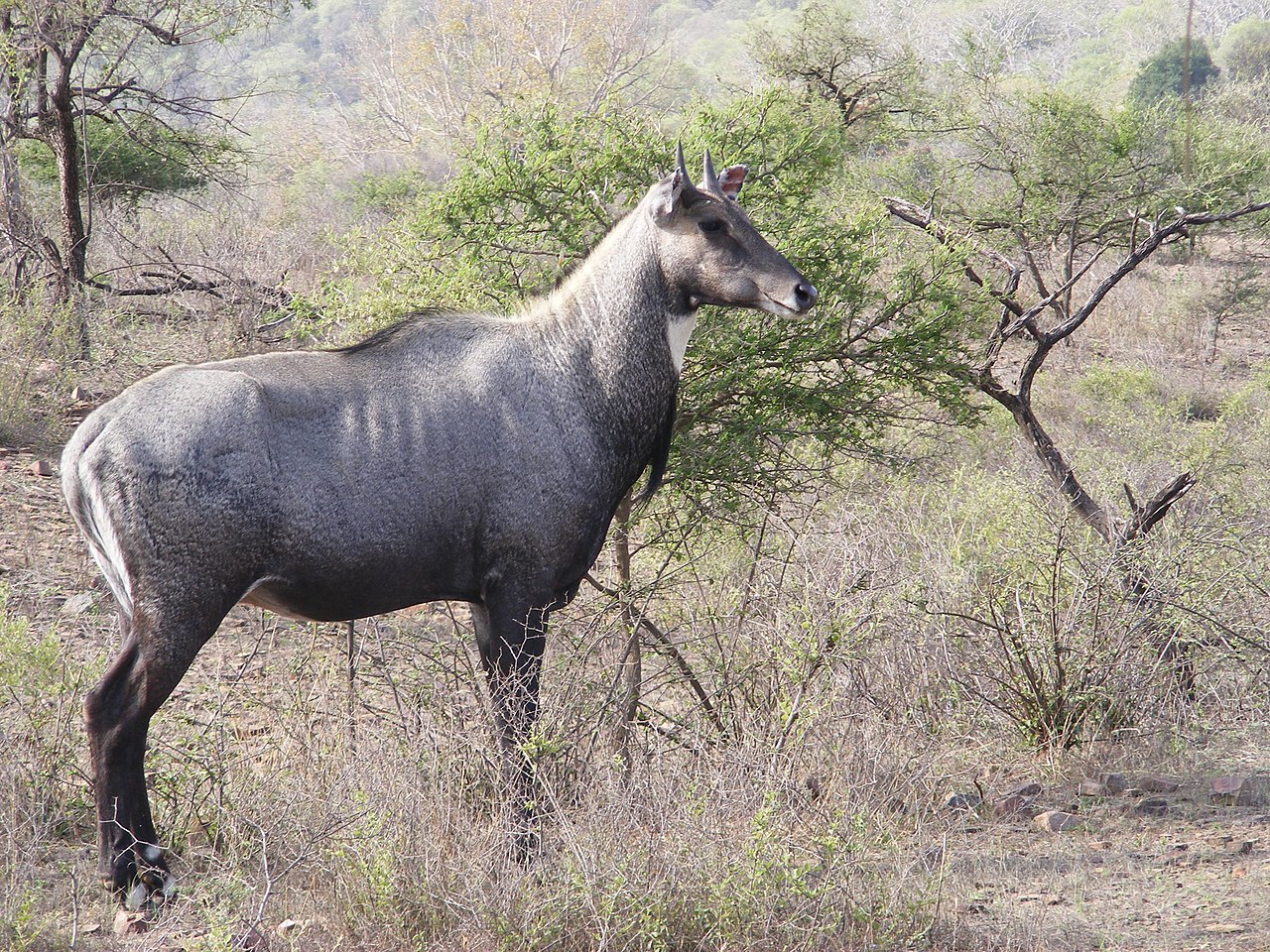
Across the plains of India roam two remarkable antelopes: the elegant blackbuck and the imposing nilgai, or “blue bull.” For centuries, these animals have lived not only in the landscape but in the imagination of the subcontinent, their forms etched into Mughal paintings and echoed through ancient texts. Their significance stretches beyond natural history into the realm of the sacred. The blackbuck, said to pull the chariot of Lord Krishna and revered as the vahana (mount) of Vayu, the god of winds, holds a special place in Hindu tradition. The nilgai, with its towering frame and subtly contoured horns—so reminiscent of domestic cattle—carries a sanctity of its own; its very name, meaning “blue cow,” hints at a spiritual kinship that has long granted it protection and respect. Here, in these creatures, the story of India’s wildlife and its cultural soul intertwine.
 |
| Blackbuck |
Yet even creatures wrapped in centuries of reverence can find themselves in conflict with the people who share their land. For many farming communities, blackbucks and nilgais have become habitual raiders of precious crops, prompting several states to resort to culling in an effort to stem the losses. But in Madhya Pradesh, a gentler solution has taken shape—one that seeks to preserve both livelihoods and lives. In an ambitious 11-day operation, the state’s forest department, working alongside a 15-member specialist team from South Africa’s Conservation Solutions, undertook the relocation of 913 antelopes from farmland to forest. Conservationists trained local officers in the art of humane capture before the fieldwork began. From above, a Robinson-44 helicopter guided the animals toward a carefully constructed “boma”—a wide, funnel-shaped enclosure woven from grass and green netting, designed to usher the herds safely inside. Once secured, the antelopes were transported to protected havens including Gandhi Sagar Sanctuary, Kuno National Park, Nauradehi Wildlife Sanctuary, and Veerangana Durgavati Wildlife Sanctuary. According to Forest Divisional Officer Beerendra Kumar Patel, who oversaw the mission, the method ensured the animals experienced as little stress as possible. Veterinarians, he added, relied on remote dosing techniques to administer medicines when needed—an approach that kept the operation calm, controlled, and remarkably humane.
 |
Illustration of a lady and a blackbuck.
|
In the end, this humane approach to managing blackbuck and nilgai numbers has done more than simply shield crops from damage; it has fostered a renewed trust between local communities and the forest authorities. Villagers, once frustrated by the nightly incursions of large herds, became partners in the effort, sharing vital information that helped guide the relocation teams. The project has also drawn wide commendation—from Chief Minister
Mohan Yadav to
Shajapur MLA
Arun Bhimawad—who hailed the initiative for bringing long-awaited relief to farmers whose livelihoods had been repeatedly threatened. As a pilot project, its success signals a promising new chapter in human–wildlife coexistence. A strategy that protects both people and antelopes, carried out with care, expertise, and respect, stands as a rare and welcome model. One hopes that this thoughtful, non-lethal method will inspire similar efforts across India, wherever the delicate balance between agriculture and wildlife still hangs in the balance.
.jpg/1920px-Nilgai_(blue_bull).jpg)


No comments:
Post a Comment