Saturday, February 7, 2026

Nature Reborn- From Desert to Oasis in Kuwait’s First Private Wildlife Sanctuary

Shabeeb Mubarak Al-Ajmi 

About 50 kilometers southwest of Kuwait City, in the heart of a stark desert, lies a remarkable sanctuary often regarded as the country’s first private nature reserve. Here, gazelles and the iconic Arabian oryx roam freely across a landscape slowly transformed into a lush haven. This oasis of life is the vision of environmental activist Shabeeb Mubarak Al-Ajmi, who over the past four years has devoted himself to collecting, cultivating, and preserving a diverse array of plant species. What was once barren sand is now a thriving, sustainable ecosystem, with over 27 plant species—including 14 native to Kuwait—creating a vibrant backdrop that comes alive in the spring.

Arabian oryx in the reserve.

Al-Ajmi described the antelopes’ lives with warmth and care: they are fed clover and fodder, reproduce naturally every eight months, and thrive without human interference—a testament to the reserve’s balanced habitat. He likens his bond with the animals to that of a father with his children, yet he is ready to release them into official reserves under the Environment Public Authority to support ecotourism. Speaking of the Arabian oryx, he takes pride in maintaining purebred animals and emphasizes Kuwait’s pivotal role in protecting the species, honoring the legacy of the late Sheikh Jaber Al-Abdullah Al-Sabah, a pioneer in international oryx conservation.

Al-Ajmi and a staff worker tending to gazelles.

Looking ahead, Al-Ajmi hopes the project will gain official backing to further Kuwait’s environmental objectives and raise public awareness. He stresses that the sanctuary’s success is a collective effort, supported by the volunteer group “Our Environment,” which aims to turn the reserve into a scientific and educational hub. Through research programs, workshops, and awareness courses, the site welcomes students, researchers, and environmental enthusiasts, nurturing a generation attuned to sustainability. Beyond being a refuge for wildlife, the reserve demonstrates how dedication, patience, and love for nature can transform even the harshest desert into a thriving ecosystem—sending a powerful message that life can flourish wherever care and vision are applied. 

The Risk Behind Recovery- What the Death of Wolf No. 2305 Reveals

A northwestern wolf wearing a radio collar.

Wildlife conservation efforts rely heavily on strict safety protocols, particularly during critical interventions meant to support the survival of vulnerable species. Despite these safeguards, operations do not always unfold as intended. Such was the case with a breeding male wolf from Colorado’s King Mountain wolf pack, which died on January 28 during a collaring operation conducted by Colorado Parks and Wildlife (CPW) staff in Routt County. The three-year-old wolf, identified as No. 2305, had been captured in Oregon and released in Grand County in 2023. According to CPW Acting Director Laura Clellan, both agency staff and contractors adhered to established animal care guidelines throughout the operation. However, when the wolf was transferred from the capture site to CPW field personnel, he was found unresponsive. Despite immediate resuscitation efforts, staff determined that the animal had died. Clellan noted that while CPW has previously conducted successful capture operations, this incident has led the agency to temporarily suspend such activities while it reviews the circumstances surrounding the wolf’s death. To determine whether underlying health issues may have contributed, CPW conducted a necropsy at its Fort Collins health laboratory. Final laboratory results are still pending. The U.S. Fish and Wildlife Service authorized the necropsy, as the death of No. 2305 was not considered a potential law enforcement matter. 

No. 2305 was the first wolf to die during a collaring operation in Colorado and the twelfth wolf released as part of the state’s reintroduction effort. In January 2025, an additional 15 wolves were released in Eagle or Pitkin counties after being relocated from British Columbia. Of those animals, three collared wolves—two gray females, No. 2504 and No. 2506, and one male, No. 2513—were later found dead under unexplained circumstances, with mortality investigations still ongoing. The U.S. Fish and Wildlife Service has also conducted necropsies on several wolves that have died in Colorado, and those results remain pending. The death of No. 2305 underscores the reality that even when conservation protocols are carefully followed, unpredictable factors can arise and alter outcomes. Such setbacks are an inherent part of wildlife conservation and should not be viewed as insurmountable obstacles. While the loss of No. 2305 introduces uncertainty—particularly regarding its potential impact on the King Mountain pack and Colorado’s broader wolf recovery efforts—CPW wolf conservation program manager Eric Odell emphasized that the agency will continue monitoring the pack to assess its status and contribution to establishing a self-sustaining wolf population in the state.       

Wednesday, January 28, 2026

At the Forest’s Edge- How Technology Is Helping Japan Coexist with Bears

Brown bear

In Japan’s northern and mountainous regions, the boundary between human settlement and wild habitat is growing ever thinner. As bears venture closer to towns and cities, encounters that were once rare are becoming increasingly common—posing risks to both people and animals. In the coastal city of Ishinomaki, in Miyagi Prefecture, local authorities are testing an unconventional response. Rather than fences or force, they are turning to technology. Specially equipped drones, designed to disperse bear repellent, are being introduced as a way to discourage bears from entering populated areas without direct human confrontation. The drones are produced by Terra Drone, a Japanese company that says the system allows bears to be deterred remotely and with precision. Operated from distances of up to half a mile, the aircraft can be deployed swiftly, keeping wildlife officers and residents out of harm’s way. An initial drone will be launched as a trial, with plans to expand the program next spring. The initiative, expected to cost several million yen, will be managed by a private operator appointed by the city. Officials hope the approach will reduce damage and defuse encounters, while allowing bears to retreat back into the surrounding forest. A demonstration video offers an early glimpse of the technology in action. Though filmed in Japanese and staged using a person in a bear costume, it reflects a broader ambition: to find new ways for humans and wildlife to share an increasingly crowded landscape.

An anti-bear attack drone equipped with bear spray. 

Bear sightings and attacks have become an increasing concern across Japan. Data from the country’s environment ministry show that reported sightings rose by 163 percent between 2021 and 2025. Since April alone, bear encounters have resulted in around 100 injuries and 12 fatalities. In response, authorities have introduced a range of countermeasures. In December, units from Japan’s Self-Defense Forces were deployed to northern regions where repeated sightings had been recorded. Their task: to install trap cages designed to capture bears that had strayed too close to human settlements. Technology has also begun to play a growing role. Alongside repellent-spraying drones, other aerial deterrents are being tested. In November, Gifu Prefecture launched drones fitted with oversized “googly eyes,” loudspeakers that mimic barking dogs, and firecrackers—an effort to frighten bears and drive them back toward forested areas before encounters escalate.

The Karelian Bear Dog; once used to hunt bears is now used to mitigate human-bear conflict.

While drones represent a strikingly innovative way to deter bears without causing harm, they are only one part of a much broader solution. Long-term coexistence depends just as heavily on prevention—particularly public awareness programs that teach bear safety and improve waste management in regions where sightings are frequent. Poorly stored food and rubbish remain among the strongest attractants drawing bears into human settlements. On the ground, more traditional methods continue to prove their worth. Specially trained hunting dogs have been used with notable success to reduce human–bear conflict. One such breed, the Karelian Bear Dog, was originally developed in Finland to confront large and dangerous wildlife. Today, its natural prey drive is employed not to hunt bears, but to drive them away. By standing its ground—barking persistently and nipping when necessary—the dog teaches bears to associate human areas with discomfort and risk. In Japan, these hardy dogs were first introduced in 2004 in Karuizawa, a popular resort town near Tokyo. The results were striking: reported bear incidents fell from 255 in 2006 to just four by 2017. Wildlife managers attribute this success to both the dogs’ presence and scent, which discourage repeat incursions. Their effectiveness, however, depends on careful application. The dogs are not used solely to chase bears away in the moment, but also as part of a process known as “hard release.” In this method, dogs are used to intimidate a captured bear before it is released back into the wild—often accompanied by loud noises such as bean-bag rounds fired into the air. The aim is to recondition the animal, reinforcing a lasting fear of human spaces. Taken together—public education, improved waste practices, drone technology, capture-and-release programs, and trained dogs—these approaches point toward a more sustainable future. It is through this layered strategy, rather than any single solution, that Japan may yet achieve a lasting and peaceful coexistence between people and bears.                

Monday, January 26, 2026

A Fragile Comeback at a Crossroads- The Mexican Wolf and the Politics of Survival

Mexican wolf at New Mexico's Sevilleta National Wildlife Refuge.

Once driven to the very edge of disappearance across the deserts and mountains of the American Southwest and Mexico, the Mexican wolf has clawed its way back from oblivion. Decades of painstaking conservation and captive-breeding efforts have returned at least 286 wolves to the wild—a fragile but remarkable recovery. Protected under the Endangered Species Act, the wolf’s survival has long depended on this legal shield. Now, that protection hangs in the balance. A House committee has advanced a bill that would remove the Mexican wolf from the endangered list. Introduced last summer by Arizona Representative Paul Gosar and titled the Enhancing Safety for Animals Act, the proposal reflects the enduring conflict between wolves and ranchers and is set to advance to the House floor. The challenge does not end there. Additional bills introduced this year by Representative Lupe Diaz would allow private landowners to obtain permits to kill wolves on private property and even open the door to sport hunting. Conservationists warn that such measures could unravel decades of progress and push the species back toward extinction. “This is very bad news for the wolves,” said Michael Robinson of the Center for Biological Diversity—an echo of a wider fear that the Mexican wolf’s hard-won return to the wild may once again be at risk.

Rep. Paul Gosar

In the wild today, the Mexican wolf clings to recovery with a population of just 286 animals, as of 2024. Under the strict benchmarks of the Endangered Species Act, that number still falls short—true downlisting is permitted only once the population reaches at least 326. Yet, in a move that startled conservationists, the House Natural Resources Committee has backed the Enhancing Safety for Animals Act, a bill that would remove the wolf from the endangered species list altogether. The proposal is one of four measures introduced amid growing frustration from ranching communities, who argue that wolves prey on livestock and household pets, inflicting financial strain on rural Arizona. But critics warn that delisting could undermine the very recovery it claims to address. Arizona’s wolf conservation program depends heavily on federal funding tied to the ESA, and that support is now in limbo. The effects are already visible. A stall in federal funding has halted coordinated aerial surveys across Arizona and New Mexico—vital tools for tracking wolf numbers. Forced to adapt, wildlife officials now conduct surveys by foot and vehicle, a slower and less effective approach. As Jim deVos of the Arizona Game and Fish Department explains, without helicopters, keeping watch over one of North America’s rarest predators becomes a far greater challenge.

Gila National Forest, one of many places home to Mexican wolves.

The U.S. Fish and Wildlife Service reports that livestock losses linked to Mexican wolves have been declining since 2022. Yet, despite this downward trend, wolves remain firmly in the political crosshairs. At both state and federal levels, lawmakers are advancing bills that would strip the species of its endangered status—moves that conservationists say risk undoing decades of fragile progress. In the landscapes of the American Southwest, the Mexican wolf plays a quiet but vital role, shaping the balance of forests and grasslands. Conflicts with livestock, scientists argue, are less a symptom of wolf behavior than of human transformation of the land—where wild habitat has been converted to ranches and natural prey has been pushed aside. There are alternatives. Non-lethal measures, such as the use of livestock guardian dogs, have proven effective in protecting cattle while allowing wolves to survive. By contrast, shooting wolves on sight threatens not only their recovery, but the health of the ecosystems they help sustain. Critics also warn that removing federal protections now would violate the Endangered Species Act itself, given that recovery targets have not yet been met. Compounding the risk, delays in federal funding are already weakening efforts to monitor wolf populations, leaving scientists with an incomplete picture of how well the species is truly faring. The future of the Mexican wolf, it seems, hinges not on conflict, but on cooperation—between ranchers, conservationists, lawmakers, and communities—working together to find a way for people and predators to share the same land in peace.               

Saturday, January 10, 2026

Returning the King- Saudi Arabia’s Asiatic Lion Project

Asiatic lion
Once true to its name, the Asiatic lion roamed a vast realm that stretched from the forests of India to the plains of Greece. Its presence is etched into human history—carved into Mesopotamian and Iranian reliefs, cast in sculptures and statues, and woven into the stories of ancient texts. From the biblical tales of Daniel, David, and Samson to the Greek legend of Hercules, the lion stood as a symbol of power and awe. Yet the most compelling testimony to its former dominion lies buried in the earth itself, where lion bones have been uncovered at archaeological sites across these regions. Over centuries, relentless hunting and the steady loss of habitat drove the Asiatic lion from Greece and West Asia, with the last confirmed sighting in Iran recorded in 1942. In India, it vanished from the north and the heart of the subcontinent, surviving today only in a final stronghold—the Gir Forest of Gujarat.

Andrew Zaloumis, CEO of Prince Mohammed bin Salman Royal Reserve

Now, a bold vision is taking shape in the deserts of Saudi Arabia. Within the vast expanse of the Prince Mohammed bin Salman Royal Reserve, plans are emerging to return the Asiatic lion to a land it once knew. The proposal forms part of an ambitious conservation program aimed at restoring 23 endangered or locally extinct species across the kingdom. Progress is already visible. Last year, the Persian onager—native to Iran—was released into the reserve, stepping into the ecological role once filled by its closest genetic relative, the now-extinct Syrian onager. Earlier, in 2022, Arabian oryx were reintroduced, their numbers steadily rising to 86 today. Preparations are also underway for the return of the Arabian leopard, with breeding programs established in the city of Ta’if. Yet the lion’s homecoming remains undecided. According to the reserve’s chief executive, Andrew Zaloumis, no timeline has been set, and discussions are still at the consultation stage—though they have met no resistance from the board of directors, chaired by Crown Prince Mohammed bin Salman. Alongside these plans, the reserve works closely with local communities, holding regular consultations and prioritising local recruitment, seeking to ensure that conservation and coexistence go hand in hand.

View of Prince Mohammed bin Salman Royal Reserve.

Evidence of the Asiatic lion’s former presence in Arabia is written into the stone itself. Ancient rock carvings, some more than 10,000 years old, bear silent witness to a predator that vanished from the region by the 19th century. Today, with plans for its return, Saudi Arabia could become only the second nation—after India—to once again host wild lions. The Prince Mohammed bin Salman Royal Reserve offers a landscape vast enough to sustain such an ambition. Spanning 24,500 square kilometres—more than twice the size of Lebanon—it surpasses even Kruger, the Serengeti, and Yellowstone in scale. Within its boundaries lie fifteen distinct ecosystems, rising to peaks over two kilometres in the Hejaz Mountains, stretching across the volcanic lava fields of the Harrat Plateau, and plunging to depths of a thousand metres beneath the Red Sea, where deep-water corals flourish. Across this extraordinary range, more than 300 species of birds, mammals, and plants have already been recorded.

A herd of Persian onagers in the reserve.

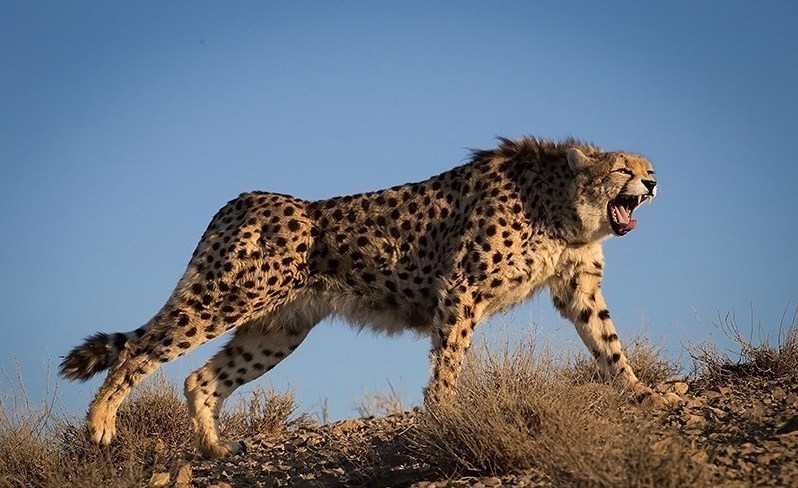
While plans to return the lion remain under discussion, conservationists agree that the immediate priority lies elsewhere. The Arabian leopard, a subspecies now teetering on the edge of extinction, numbers no more than 100 to 120 individuals worldwide, and its population is believed to be in decline. In response, captive breeding programs have been established across the region—in Israel, Oman, the United Arab Emirates, Yemen, and Saudi Arabia—offering a fragile lifeline to this elusive predator. Though smaller than the lion, the Arabian leopard fulfils a similar ecological role, helping to maintain balance within the Middle East’s terrestrial ecosystems. Only once these populations are securely restored would conditions be right for the return of the lion, whether in Saudi Arabia or elsewhere in West Asia where it once reigned. As with the leopard, any future reintroduction of the Asiatic lion would depend on carefully managed captive breeding, made possible through close collaboration between conservation organisations, governments, and local stakeholders.

Tuesday, December 23, 2025

Rooted in Resilience- Tiger Widows Restoring the Sundarbans

Women collecting mangrove saplings in the Sundarbans.

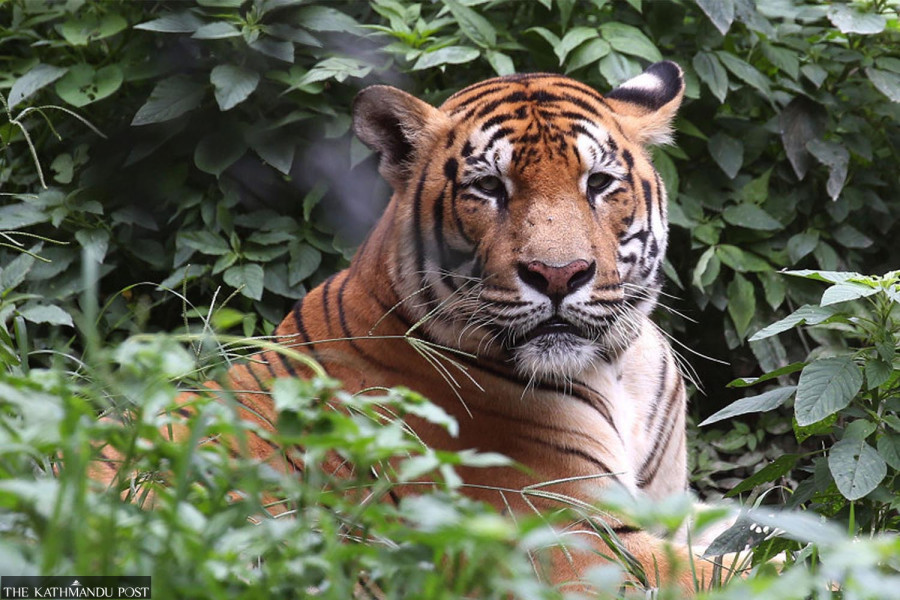
The Sundarbans is an immense expanse of mangrove forest, threaded by a labyrinth of tidal channels where the Ganges, Brahmaputra, and Meghna rivers converge before meeting the Bay of Bengal. Spanning the border between India and Bangladesh, this UNESCO World Heritage Site is one of the world’s richest and most fragile ecosystems. It is home to an extraordinary range of wildlife, including a population of tigers unlike any other. In this watery realm, tigers have adapted to an amphibious existence, swimming vast distances between forested islands in pursuit of prey such as fish and crabs. With an estimated 125 tigers living across the region in Bangladesh and around 88 on India's side, their population remains resilient. Yet as deforestation accelerates and human settlements push ever closer to the forest’s edge, encounters between people and predators have become increasingly unavoidable. Official records of such conflicts are limited, but estimates suggest that 300 people and 46 tigers have lost their lives over the years. Most of the human victims are men who enter the forest to fish or to gather honey and firewood. Their absence is etched into village life through the presence of so-called “tiger widows.” Known locally as swami khejos, or “husband eaters,” these women have long been burdened with stigma, blamed for tragedies beyond their control. Branded as outcasts, many are denied livelihoods and excluded from government compensation, particularly where deaths are linked to illegal forest entry. Left with little means of support, they must navigate a life shaped by loss and isolation. Among them is Malati Mondal, whose husband was killed by a tiger nearly a decade ago while fishing in the creeks of the Sundarbans.

A tiger wearing a radio collar on a riverbank in the Sundarbans, having been released by wildlife officials after being caught too close to human habitation.

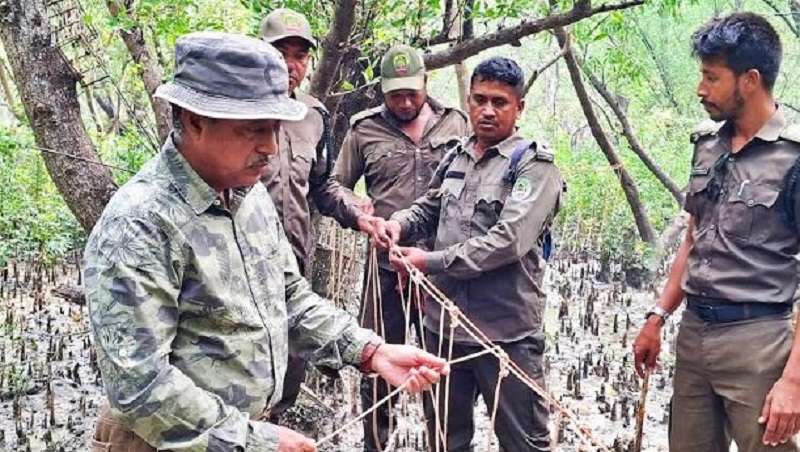
But a new conservation effort is beginning to shift that story. Designed to support tiger widows and their families, the initiative seeks not only to restore livelihoods and dignity, but also to heal the fragile environment on which both people and wildlife depend. Known as Mountains to Mangroves, the program is led by Conservation International and stretches from the Himalayas to the Sundarbans, with the ambitious goal of restoring one million hectares of forest. In the Sundarbans, its work is centred on the Jharkhali region along the Matla River. Here, the project is being led by 26-year-old Shahif Ali, founder of i-Behind The Ink, a social enterprise running a youth-led rewilding initiative. Ali has brought together tiger widows and other local women to revive 100 hectares of mangrove forest. At present, more than 100,000 native mangrove saplings are being planted across 40 hectares of coastline between the villages of Laskarpur and Vivekananda Palli. Raised and carefully tended by the women over the past six months, the young trees are now being set along a single embankment—the community’s only defence against rising seas and storm-driven floods. The aim is to regenerate dense mangrove cover lost to farming and fishing, while strengthening natural protection against cyclones that are growing ever more frequent and intense as the climate warms. The restored forest is also expected to slow the spread of saltwater intrusion, which threatens mangrove health, degrades farmland, and disrupts fish populations. Over time, as fish return, both people and predators may find more abundant food—reducing the likelihood of conflict. Malati Mondal is one of seven tiger widows currently taking part among a group of 59 women. Twenty more widows are set to join later this month, and according to Ali, interest is growing rapidly. The women earn around 300 rupees a day—modest by most measures, he says, but enough to bring meaningful change.

An aerial view of a fishing boat in the Sundarbans. Fishermen who venture deep into the forests are at risk of tiger attacks.

There is a quiet power in the fact that women who once lost their husbands to tigers are now helping to safeguard the future of the Sundarbans. Through their work, mangrove forests are beginning to recover, livelihoods are being rebuilt, and dignity—long denied—is slowly being restored. Paid for their labour and recognised for their contribution, these women are reclaiming a place within their communities. Mountains to Mangroves is not the only effort breathing new life into this landscape. In 2005, a local organisation known as Jharkhali Sabuj Bahini—the Jharkhali Green Army—was founded by Akul Biswas, a visually impaired environmentalist who found purpose in tree plantation. What began with roadside planting took on new urgency after Cyclone Aila struck in 2009, revealing the vital role mangroves play in shielding the land from saltwater intrusion and flooding. Biswas launched a campaign to restore mangrove cover, drawing in villagers from all walks of life—children, people with disabilities, homemakers, and tiger widows among them. Over time, their efforts spread beyond Jharkhali, inspiring neighbouring communities to join the movement. Together, these initiatives offer a measure of hope for the Sundarbans’ long-term survival. Restoring this fragile ecosystem is not only about protecting forests or wildlife, but about rebuilding lives and easing decades of conflict. If the mangroves can recover, there is a chance that people and predators alike may once again learn to share this shifting, water-bound world.                

Friday, December 19, 2025

Operation Thunder- A Global Manhunt for Wildlife Traffickers

A caged monkey holding a human hand.

For the ninth year running, a vast international crackdown known as Operation Thunder has swept across the globe, targeting the shadowy networks that illegally trade in wildlife. Led by INTERPOL and the World Customs Organization, and backed by the International Consortium on Combating Wildlife Crime, the operation united police, customs officers, border forces, and wildlife authorities from 134 countries in a rare show of global cooperation. Months before a single seizure was made, investigators quietly exchanged intelligence, traced smuggling routes, monitored online marketplaces, and prepared coordinated inspections across continents. Then, between September 15 and October 15, the operation moved into action. The results were unprecedented: 4,640 seizures worldwide and nearly 1,100 suspects identified in connection with the illegal trade in wildlife and forest products. What authorities uncovered was staggering. Tens of thousands of protected plants and animals were confiscated, alongside more than 30 tonnes of endangered species listed under CITES and vast quantities of illegally logged timber. The scale of the seizures revealed a troubling trend—live animal smuggling has reached its highest recorded level, driven largely by the growing demand for exotic pets. Among those rescued were more than 6,000 birds, over 2,000 tortoises and turtles, 1,150 reptiles, 208 primates, and even 10 big cats, including tigers. In one striking case, investigators in Qatar arrested a suspect who had attempted to sell an endangered primate online for $14,000—just one transaction in a global trade that continues to push countless species closer to extinction.

White-cheeked gibbons and lorises rescued.

But the investigation revealed that live animals were only one part of a far broader and more disturbing trade. Far greater in scale was the trafficking of animal parts, meat, and derivatives—destined for luxury goods, niche food markets, and traditional medicine. Among the most shocking discoveries was a single shipment containing more than 1,300 primate body parts, including skulls and bones. Operation Thunder also exposed a sharp rise in the bushmeat trade. In Belgium, officials confiscated primate meat, while in Kenya authorities intercepted over 400 kilograms of giraffe meat. In Tanzania, law enforcement recovered antelope and zebra meat and skins valued at around $10,000. The trade extended beyond land animals to the world’s oceans. More than 245 tonnes of protected marine species were confiscated, including some 4,000 shark fins. And despite decades of international bans, the demand for ivory remains stubbornly strong. In France, authorities seized 107 ivory items from markets, while in Austria additional pieces were recovered from a private home—clear evidence that the illegal trade continues to thrive, often hidden in plain sight.

Tortoises found in luggage.

The operation also highlighted a lesser-known but rapidly growing threat: the trafficking of insects and spiders. Around the world, nearly 10,500 butterflies, insects, and arachnids—many protected under international law—were seized. In the United States alone, customs officers intercepted more than 40 insect shipments and 80 consignments of butterflies at a mail facility, traced back to Germany, Slovakia, and the United Kingdom.

Beyond animals, the trade in exotic plants and timber proved equally alarming. Authorities confiscated more than 10 tonnes of live plants and plant derivatives, driven largely by demand from horticultural enthusiasts and private collectors. The scale of illegal logging was stark: some 14,000 pieces of timber, totaling over 32,000 cubic meters, were seized. Investigators estimate that illicit logging may account for as much as 15 to 30 percent of all timber traded globally—underscoring how deeply embedded environmental crime has become in the global marketplace.

Summary of animals confiscated during Operation Thunder this year.

The sheer scale of the seizures made during Operation Thunder has laid bare a sobering reality: the illegal wildlife trade extends far beyond the trafficking of exotic mammals, birds, and reptiles. Insects, spiders, plants, and timber are all being relentlessly exploited to satisfy growing global demand. Among the species at risk is the Malaysian purple-femur tarantula, already threatened by habitat loss and now increasingly targeted for the exotic pet trade. Its decline has prompted the Center for Biological Diversity to urge the U.S government to grant the species protection under the Endangered Species Act—a stark reminder that few forms of life remain untouched by this trade. Operation Thunder has also revealed how profoundly the illegal wildlife market has evolved. No longer the domain of isolated poachers and small-scale black-market traders, it has become a sophisticated, cross-border industry—one that undermines ecosystems, fuels corruption, and poses growing risks to human health. Generating tens of billions of dollars each year, the trade has become deeply attractive to organized crime groups, which rapidly adapt their methods to stay ahead of enforcement.

The message is clear: illegal wildlife trafficking must be treated as a global threat on par with drug trafficking, human trafficking, and terrorism. Intelligence gathered through operations like Thunder is vital to mapping international criminal networks, anticipating future crimes, and dismantling supply chains before they inflict further damage. And just as crucially, those orchestrating this trade must face the strongest possible penalties—reflecting the scale of harm their actions inflict on both the natural world and human society.