Saturday, December 5, 2020

Commencement of Habitat Survey for Africa's Cheetahs in India


A cheetah being photographed in Africa

The cheetah reintroduction project in India has begun with a survey to find a suitable habitat for Africa's cheetahs. M.K Ranjitsinh, former director of Wildlife Preservation of India, stated that the survey has been initiated by a team of researchers under the supervision of the Wildlife Institute of India (WII). Dr. Ranjitsinh is part of a three-member committee formed at the order given by the Supreme Court early this year. The two other members are WII director Dhananjai Mohan and the Deputy Inspector General (Wildlife) at the Ministry of Environment, Forest, and Climate Change (MoEFCC). The ministry has authorized a total of Rs. 2.5 crore to the WII for the cheetah project. A WII report written by Dr. Ranjitsinh and big cat expert Y.V Jhala ten years ago examined the possibility of cheetah reintroduction in the following protected areas: 
According to the report, the authors suggested Kuno Palpur and Nauradehi Wildlife Sanctuaries and Shahgarh Landscape for the reintroduction. They further added that all three sites need preparation and resource contributions to start an introduction. They also emphasized the need for long-term political will, personnel, and resources from both central and state governments to successfully carry out this project. The protected areas in Chhattisgarh, on the other hand, were ruled out due to issues like low prey densities. 

A view of Kuno Palpur Wildlife Sanctuary

The report evaluated Kuno Palpur Wildlife Sanctuary to have a current capacity to maintain 27 cheetahs. However, the authors pointed out that combining neighboring forested areas to the sanctuary can accommodate 32 individuals. In addition, the surrounding 3,000 sq. km habitat can be maintained as a buffer to the sanctuary. This way, the location can hold distribution of 70 cheetahs. The authors also advised designating 750 sq. km as a core area of Nauradehi Wildlife Sanctuary and relocating 23 human settlements from the area with generous and proper compensation. This would allow the sanctuary to accommodate over 50 cheetahs as a source population, while the entire landscape could support over 70 individuals. The Shahgarh Landscape was also found to be an ideal location for cheetahs. Because it is fenced along the Indo-Pakistan border, the authors suggested it to be fenced off by building another 140 km-long chain-link fence to include roughly 4,000 sq. km of habitat. They also recommended relocating local people from 80 seasonally used settlements. They also mentioned that the area could accommodate 15 cheetahs and has the capacity to support 40 individuals with further habitat management.
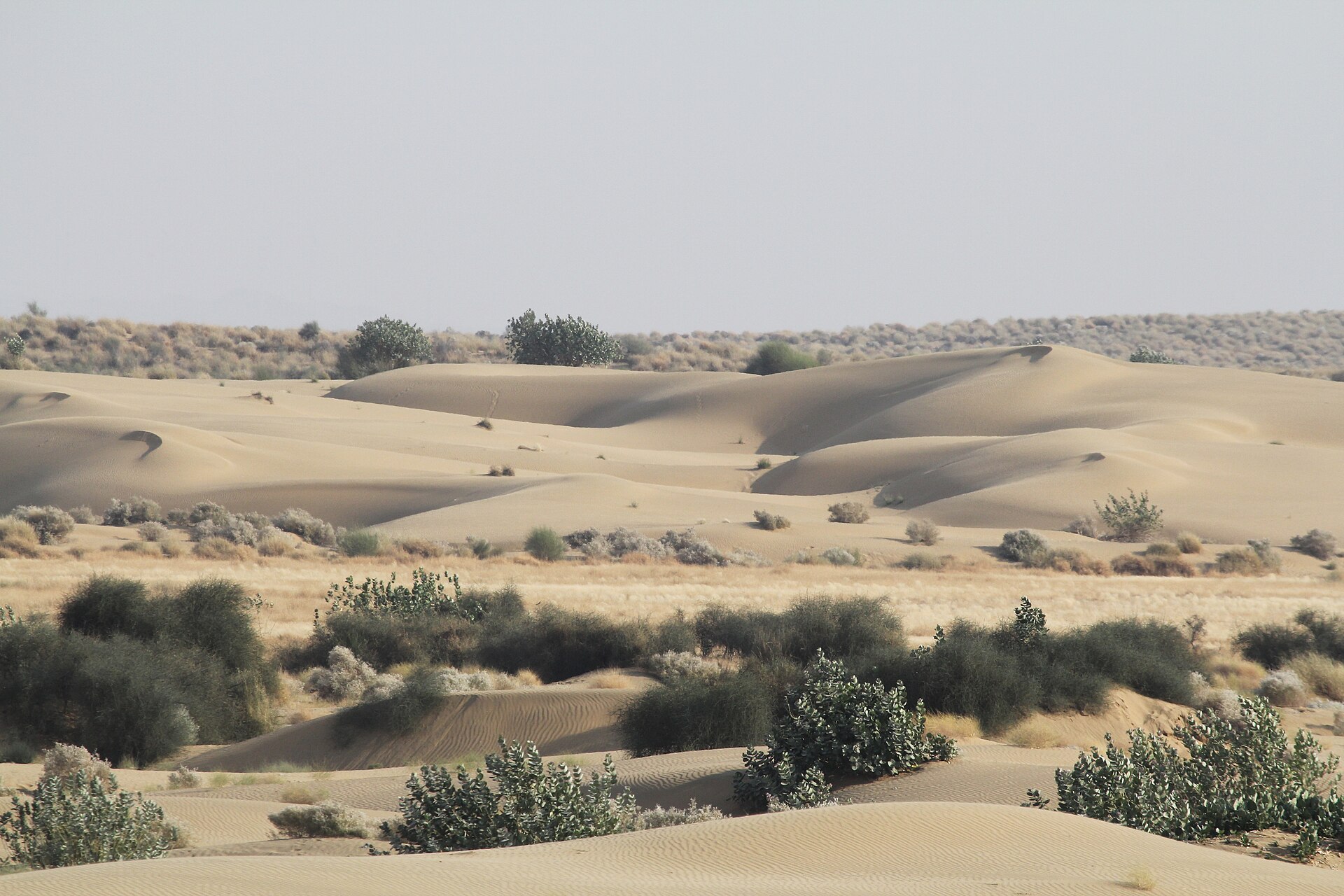
A view of sand dunes in Desert National Park

I find it to be a major news that a habitat survey has begun for reintroducing the cheetah in India. To me, it indicates the first step in the country's cheetah reintroduction project. I'm equally impressed that the WII report written by Dr. Ranjitsinh and Dr. Jhala in 2010 has been mentioned in this news. This report has given detailed information about the cheetah reintroduction project, including the identified sites of release. One of those sites is Kuno Palpur Wildlife Sanctuary, which also happens to be the release site for Asiatic lions. Dr. Ranjitsinh assured that there would not be any conflict between cheetahs, lions, and tigers in the sanctuary. However, I still think it is crucial to closely monitor the cheetahs to see how well they are adjusting with their larger feline counterparts. Rajasthan's Desert National Park and Shahgarh Landscape are, without question, ideal habitats for cheetahs outside Africa. The area encompassing these two sites is made up of sweeping sand dunes much like the ones in Namibia, from where cheetahs will be brought. Both the sites are home to the chinkara (Indian gazelle), which historically was an ideal prey for the cheetah in India. However, the state chief wildlife warden Arindam Tomar expressed his concern over the growing tension between India and Pakistan with Shahgarh Landscape situated along the border. I think it is highly essential to tackle this volatile situation to ensure proper safety for cheetahs before releasing them. I also think it is crucial to take measurements to deal with situations like poaching, which is attributed to low prey densities in Chhattisgarh's protected areas. These sites were home to cheetahs and they continued to survive there until after India gained its independence. Overall, I find this news gives a sense of optimism in bringing the cheetah back to India and let us see what happens later.

View article here                 

Friday, December 4, 2020

Alleviation of Poverty and Unemployment Essential in Fighting Poaching in South Africa


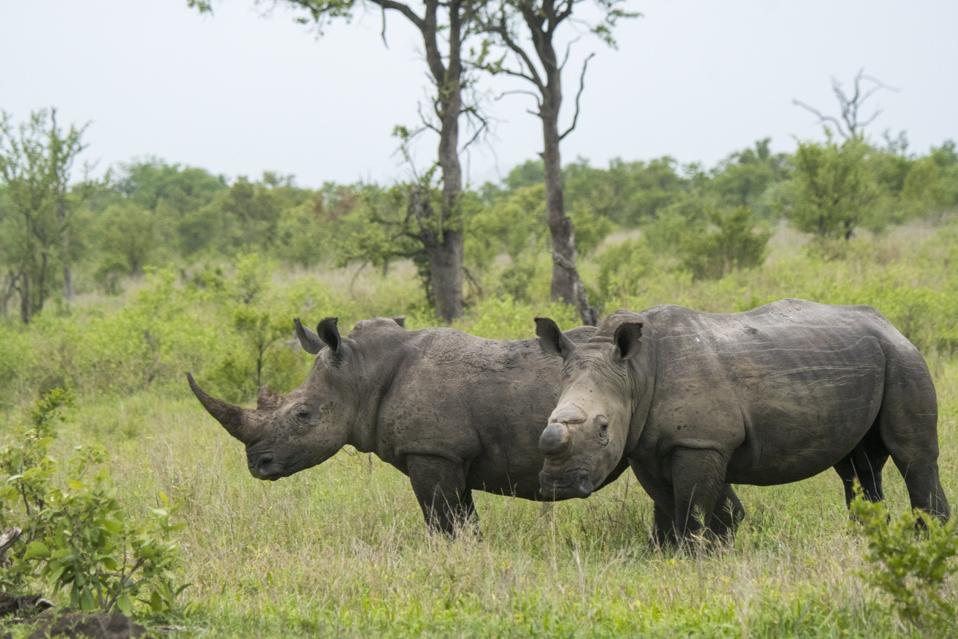
A pair of white rhinos - one dehorned to discourage poachers - in Kruger National Park. 

Whenever there are incidences of poaching, the typical response is to investigate the crime scenes, identify the suspects, arrest the suspects, and convict them. In addition, strict laws are implemented to warn people of the consequences of poaching. However, what most people overlook is that it is connected to poverty and unemployment in countries where poaching is rampant. This was seen in an interview conducted by TRAFFIC. The interview was geared at 73 people from South Africa's correctional institutions. Many of them were youngsters with less than high school education, who admitted to have participated in the illegal wildlife trade due to unemployment and peer pressure. One interviewee claimed that he could earn more by selling two rhino horns than what most people in his community earn in a whole year. Another explained his involvement due to his legal job being seasonal. In the midst of restricted opportunities and very unequal society, the interviewees had noticed that the people with the money are the ones who had engaged in the illegal wildlife trade. Furthermore, none of these youngsters were ever informed about the severity of penalties towards poaching. This was seen when one interviewee explained how he thought he would serve only six months for rhino poaching, but ended up serving ten years.

A tracker dog and its handler at the Kruger National Park K-9 Center. 

It really disturbs me how youngsters are becoming involved in illegal poaching in order to make ends meet. These kids are forced to give in to peer pressure, due to high levels or poverty and unemployment in South Africa. This study conducted by TRAFFIC should be taken into serious consideration in efforts to mitigate poverty and unemployment in the country. Just enforcing anti-poaching laws followed by arresting and convicting poachers alone will not alleviate poaching and the illegal wildlife trade. South Africa is infamous for having the highest economic inequality in the world. The high levels of poverty and unemployment are directly linked to the country's high crime rate. Criminals consist of not just adults, but youngsters too. It is highly essential to conduct large-scale awareness programs targeted at the local youth. These programs should be designed to educate them about poaching and illegal wildlife trade and what they should do in order to help mitigate them. I also strongly urge the South African government to conduct measurements to alleviate poverty and unemployment in the country as a whole. This includes eliminating corruption and guaranteeing that wildlife officers and other authorities are properly paid for their work in ensuring safety for both people and wildlife.

View article here   

Friday, November 27, 2020

Ganges River's Plastic Pollution Needs to be Mitigated


Waste fishing gear

A recent research study has shown that waste fishing gear in the Ganges River is threatening the wildlife. The study has stated that entanglement in the gear can harm threatened species such as the Ganges river dolphin and the critically endangered three-striped roofed turtle. Surveys from the Himalayas to the mouth in Bangladesh indicated that waste fishing gear levels were highest near to the sea. The most common type of fishing gear recorded were nets. The local fishermen disclosed that large amounts of fishing equipment are being dumped into the river. The reason for this is because of short gear lifespans and scarcity of proper waste disposal systems. This study was led by researchers from University of Exeter with an international team of researchers from India and Bangladesh. It was carried out as part of the National Geographic Society's "Sea to Source: Ganges" expedition. The researchers used a list of 21 river species of "conservation concern" recognized by the Wildlife Institute of India (WII). They combined current information on entanglements of similar species worldwide with the new information of waste fishing gear levels in the Ganges to evaluate which species are at most risk. According to Dr. Sarah Nelms of the Center for Ecology and Conservation, the fishermen would try to mend and reuse the nets if possible; but if they are unable to, then they discard them in the river. Professor Heather Koldewey, a National Geographic Fellow and co-leader of the expedition, stated that the study's data brings hope for solutions based on a "circular economy."
An illustration of the three-striped roofed turtle

I really think that the findings made by this expedition should be taken into serious consideration. The Ganges River is threatened by pollution in the form of discarded nylon fishing gear, which local fishermen are unable to mend. It is highly crucial to raise awareness of the environmental impact waste fishing gear can have on the Ganges, especially with the local view that the river "cleans it away." It is equally essential to set up waste disposal systems to properly dispose of unusable fishing gear. Furthermore, I strongly believe it is necessary to establish a series of recycling programs geared at turning nylon into other useful products. This would not only decrease plastic pollution, but provide income to the local communities along the Ganges. Professor Koldewey gave an example of how such a project was conducted in the Philippines and turned out successful. The plastic pollution in the Ganges is a complex problem which requires several solutions to benefit both communities and the wildlife. Among the wildlife is the three-striped roofed turtle, which is a critically endangered species on the brink of extinction and the Ganges river dolphin. The Ganges River needs to be efficiently conserved and time is of the essence.

Monday, November 9, 2020

Reintroduction of Wolves in Colorado is Highly Essential

Gray wolf


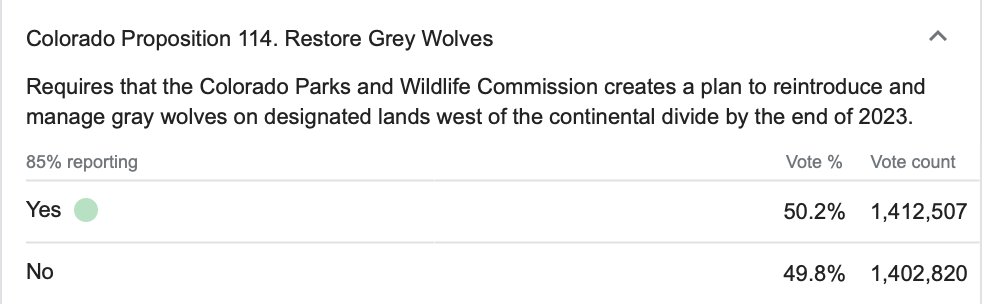
 Last week, the Trump administration announced the removal of wolves from federal protection in the lower 48 states stressing that the animals had already made a successful comeback. The decision was challenged by conservationists, who argued for putting more focus and effort on coexistence with wolves and restoring their endangered species status. But now, there is hope on the horizon with a recent news of Colorado having voted on a proposition to reintroduce wolves into the state. The proposition, known as Proposition 114, requires the Colorado Parks and Wildlife Commission to construct a plan to reintroduce wolves into the state west of the Continental Divide by the end of 2023. It also guarantees that ranchers should be compensated for any livestock loss. The proposition demonstrated for the first time voters proclaimed whether or not to reintroduce an animal. The votes were pretty separated between urban and rural areas, with ballots coming from communities around major cities such as Boulder, Denver, and Colorado Springs.

Proposition 114 won the Colorado state election.

I find that Proposition 114 winning the Colorado state election gives a great deal of hope for wolves. They had been eradicated from Colorado since the mid-1940s to make way for development and livestock in the state. Bringing them back to Colorado would ensure restoration of balance to the state's ecosystems by culling deer and elk herds that have had an uptick of chronic wasting disease. Also, conservationists say that wolves only inhabit 10 percent of their historic range in the U.S with majority of their populations fragmented. Reintroducing them back to Colorado has the possibility to help connect gaps between packs in the Northern Rockies, Great Lakes, and the West. According to Dr. Diana Tomback, an integrative biology professor and a member of the Rocky Mountain Wolf Project's science advisory team, this would lead to more genetic exchange and stronger future generations of wolves.

An illustration of a southern Rocky Mountain wolf. This subspecies once inhabited Colorado before becoming extinct in the 1940s.  

I'm well-aware that people are divided with respect to the perception of wolves. Some see wolves as essential to the health of ecosystems, while others like ranchers see them as a threat to their livelihoods. This division of perspectives is connected to the conflict between people and wolves. Rebecca Niemiec, an assistant professor from Colorado State University, says that bringing together people with these perspectives is crucial. Failure to do so can increase conflict between people over wolves and lead to negative results for both people and wolves. Although wolves are shy by nature and kill less than 0.01 percent of livestock as indicated by Dr. Tomback, ranchers would still be skeptical to the findings. This is why I strongly believe that ranchers should be provided with livestock guardian dogs minimize attacks from wolves without resorting to retaliatory killing. When wolves became extinct in Colorado during the 1940s, the state's ecosystems changed tremendously as deer and elk populations began to increase. It is highly essential to reintroduce them into the state to stabilize the prey populations and restore the ecosystems. If the method worked in Yellowstone National Park, it should also work in Colorado.

View article here                

Saturday, October 31, 2020

Wolves Should Be Allowed to Flourish Throughout the U.S


A black wolf captured on camera in Oregon in 2017.

The Trump administration recently announced that gray wolves will no longer be federally protected under the Endangered Species Act in the lower 48 states. This long-foreseen move has attracted both praise and criticism. Federal wildlife officials called the move a success story, similar to the ones involving the bald eagle and American alligator. Critics addressed the view as premature and have already promised to take legal action. According to Kristen Boyles, an attorney for Earthjustice, the wolves are only beginning to get a foothold in places such as northern California and the Pacific Northwest. She further added that they need to be federally protected to seek habitat in the southern Rocky Mountains and the Northeast. Other critics called the move as another environmental attack by the Trump administration, which has reduced several other environmental protections. These include protections of endangered species and migratory birds.

A pair of wolves feeding on a white-tailed deer.

From what I have seen and heard over the years, the issue of gray wolves in U.S is a very complicated matter that has pitted both wildlife and conservation groups and federal officials at odds with each other for a long time. Since 2013, the Obama administration proclaimed delisting the wolves stating that the animals' numbers have grown to the extent that they are no longer at risk of extinction. It further added that the wolves should be managed by state and tribal governments. Two years ago, wolves were delisted in Wyoming and Idaho due to constant pressure by sportsmen and agricultural groups. Consequent lawsuits saw the animals get delisted, relisted, and again delisted in Wyoming. Nowadays, wolf populations are managed by state wildlife agencies in Wyoming, Montana, and Idaho, and hunting them is allowed. Similar hunting seasons are anticipated in some states in the Midwest if the national delisting survives the court challenges.

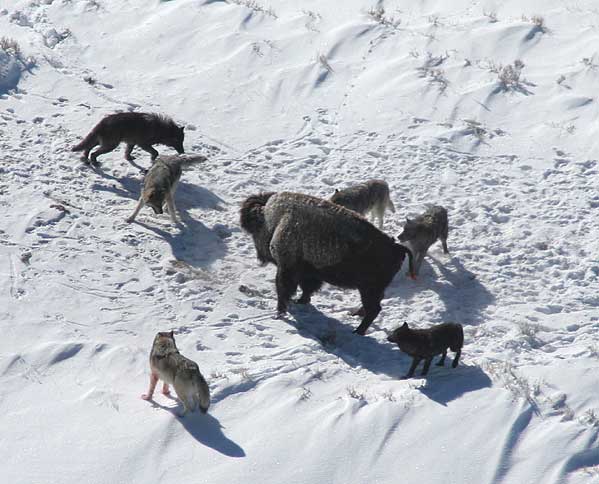
Wolfpack preying on a bison.

I feel that the future for gray wolves in the U.S is very bleak without any hope with these ongoing court battles between wildlife groups and federal officials. These animals are deliberately being prevented from repopulating other parts of the country with hunting seasons. How can an animal that once disappeared from parts of the country where it once flourished not be welcomed back? Is this called conservation? Should wolves should be kept in certain places, preferably protected areas without human intervention, and elsewhere they should be treated like common vermin? I strongly disagree with that. These animals are crucial for the health of ecosystems throughout the U.S and Canada. I strongly urge that non-lethal measurements be implemented to prevent wolves from preying on livestock. This includes providing ranchers with livestock guardian dogs to protect their cattle, sheep, and other animals. Just shooting wolves in cold blood will not make a difference, especially if the intended targets unintentionally turn out to be alpha leaders. In the wolf society, when alpha members die, the whole pack would be in disarray. Without alpha leaders to maintain order, subordinate members would recklessly go out in search for food on ranches risking the wrath of concerned ranchers. At the same time, the ranchers would suffer livestock losses while protecting them. This is why I believe that wolves should be kept as endangered species in the U.S until they inhabit more of their historical range. 

View article here 

Friday, October 16, 2020

China Secretly Supports the Sale of Pangolin Parts Despite Ban on the Trade

Pangolin

The government of China had reportedly launched a high profile crackdown on the illegal trade of pangolin parts in response to combating the covid pandemic. Pangolins are known for being carriers of coronaviruses and some people believe that they play a go-between role in hosting the Sars-CoV-2 virus which leads to the Covid-19 disease. Therefore, in February, the country placed a permanent ban on the consumption of pangolins and other wildlife. In June, it banned the usage of pangolin scales in traditional Chinese medicine and bolstered protections for its native pangolin populations. However, a recent report by the Environmental Investigation Agency (EIA) revealed that the government continues to support the sale of pangolin parts. The agency discovered that 221 companies are licensed to sell pangolin scales. Among them is the international pharmaceutical company Tong Ren Tang, whose shareholders include major western financial institutions. The report, titled Smoke & Mirrors, also showed that pangolin scale-products made in China are available for purchase on eBay, Alibaba's Taobao, and other e-commerce platforms. The EIA had earlier found out that even though pangolin scales were removed from the raw ingredients list of the 2020 edition of Pharmacopoeia, they were still listed within some 80 authorized traditional medicines. The report ended by forcing the Chinese government to "unambiguously prohibit commercial use of wildlife" and to "remove pangolins and other globally threatened species entirely from the pharmacopoeia and other nationally approved medicine lists."

Sign board of Tong Ren Tang in Beijing

In my opinion, this news has revealed the ugly truth behind China's stance on the illegal wildlife trade during the covid pandemic. Even though the country banned the consumption of pangolin and other wildlife products, it was secretly supporting the sale of such illicit products much to the chagrin of individuals and organizations involved in global wildlife protection. It is absolutely outrageous to see how the Chinese government pledges to fight against the illegal wildlife trade and at the same time support the sale of wildlife products. I strongly urge the Chinese government to take strong measurements to effectively ban the sale and consumption pangolins and it should be done without any secretive political backing of the illicit trade. This means all those companies licensed to sell pangolin products should have their licenses revoked and shut down if necessary. In addition, major e-commerce platforms like eBay should establish a strict policy against selling of pangolin and other wildlife products.

Wednesday, October 14, 2020

Trinidad and Tobago's Illegal Wildlife Trade Needs to be Dealt With


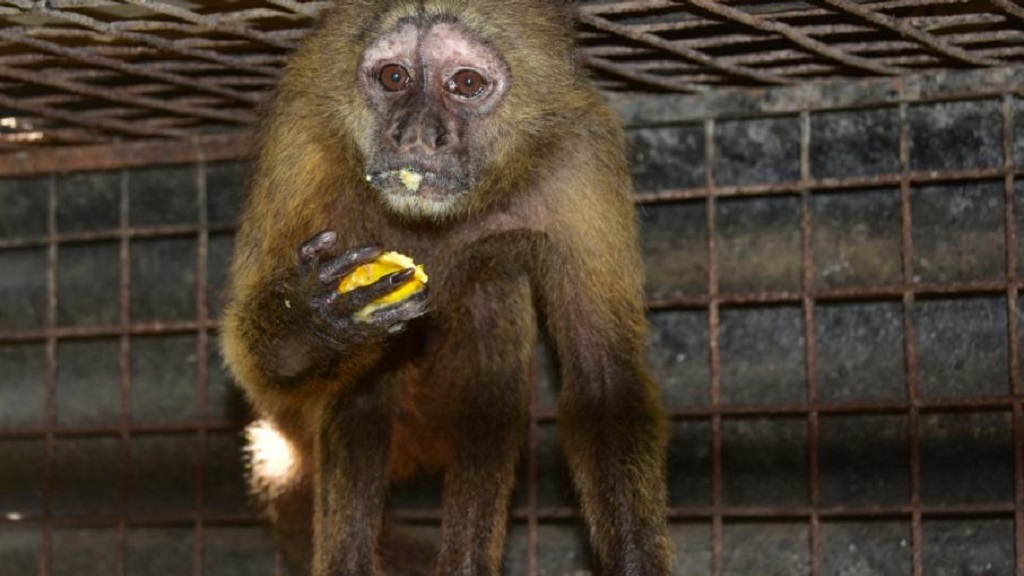
Capuchin monkey

On the island nation of Trinidad and Tobago, a conservation NGO known as El Socorro Center for Wildlife Conservation put light on the illegal wildlife trade saying it must be dealt with insistently. Its director and founder, Ricardo Meade, said in a statement that the issue is worsened by the Caribbean country's penetrable borders. He added that monkeys, which are not native to Trinidad and Tobago, are the most widely trafficked animals. They are smuggled into the country from Venezuela and Guyana. Many lose their mothers to hunters and exhibit aggressive behavior in reaction to such a traumatic experience. In addition, they are also carriers of diseases such as malaria and tuberculosis which Mr. Meade pointed out as a warning about letting monkeys loose in areas like Chaguaramas. He further added that many of the monkeys that have already been released have become a big problem to the country's ecosystems. Mr. Meade also pointed out that birds are also victims of the illegal wildlife trade and their plight is ignored by authorities. This, he warned, could lead to a destruction of Trinidad's bird population, including poultry, especially if a viral infection takes place. He blasted the careless approach from authorities who do not implement laws and called on the Ministry of National Security to focus on the illegal wildlife trade. He believes that education is required to prevent instances on the issue. In order to do so, he recommended utilizing marketing methods to involve young people and demand action.
Blue-and-yellow macaw  

I would strongly suggest taking Mr. Meade's demands and recommendations for combating the illegal wildlife trade into serious considerations. It is equally disheartening that animals like monkeys, which are not native to Trinidad and Tobago, are traumatized by the loss of their parents and venting their aggression on their so-called owners. It is also frustrating that authorities such as the police and the coast guard have a careless approach towards the issue and what problems it presents to both people and wildlife. It is highly crucial to conduct necessary measurements to educate the public about the dangers of the illegal wildlife trade, in order to involve them in the fight to call for an end to such a sadistic practice. I would also urge the authorities to refrain from having a lenient attitude towards this lucrative, yet unethical issue and take strong measurements to combat it.