Friday, August 30, 2019

Iran Must Free the Cheetah Conservationists Held Captive on Baseless Criminal Charges!

A pair of Asiatic cheetahs

In Iran, nine conservationists launched one of the most ambitious projects in the country in recent years, putting up camera traps in seven provinces to monitor the population of the critically endangered Asiatic cheetah. Despite working with the government, obtaining permit rights, and receiving funding and equipment from abroad, the team, whose members are all Iranian, drew suspicion from the Revolutionary Guard and were arrested last year for supposed espionage. Now, it has been reported that four of the nine conservationists have been charged with "spreading corruption on earth" and could face the death penalty, and four others could be sentenced to up to ten years in jail. The team, who is from the Persian Wildlife Heritage Foundation, are anticipating a verdict in a trial that rights groups say has been damaged by accusations and abuses of torture. The ninth conservationist, Kavous Seyed-Emami, was the chairman of the foundation. He was jailed last year and died while in custody. A prosecutor general from Tehran stated that Mr. Seyed-Emami, who held Canadian citizenship, died by suicide; a claim which his family and colleagues refuse to believe. The situation of the conservationists, described by family and friends as ardent champions of the environment, has underlined what analysts say an increasing criminalization of scholarly and scientific research in Iran, incited by the security forces' deep suspicion of contacts with foreign institutions.
Islamic Revolutionary Guard logo

The Revolutionary Guard has targeted researchers, academics, business executives, and dual nationals for arrest to a greater extent, and the coercive campaign is taking a particular toll on efforts to discuss a growing environmental crisis. Apart from concerns about disappearing species, Iran is encountering decreasing water resources because of fast urbanization and too much dam-building. The Persian Wildlife Heritage Foundation started using camera traps to track the shy cheetahs amidst worries over its deteriorating habitat, which is threatened by Iran's increasing mining sector and expanding road network. Scientists say that the cheetahs now number less than 50. Founded in 2008, the foundation had long worked with the country's Department of Environment, which functions under president Hassan Rouhani and had warm relations with authorities. After the arrest of the conservationists, more than 350 scientists, including Dr. Jane Goodall, signed a letter to Iran's supreme leader, Ayatollah Ali Khameini, in support of the conservationists. Earlier this year, two government agencies supervised by President Rouhani, including the country's Supreme National Security Council, cleared the researchers of crime in inquiries stimulated by Mr. Seyed-Emami's death. However, the verdict did not win their release. The Human Rights Watch disclosed that at least two members of the group, U.S-educated biologist Niloufar Bayani and project coordinator Sepideh Kashani, planned to start a hunger strike this to protest their detainment. The fate of the conservationists has become embroiled in the tensions between between President Rouhani's moderate administration, which has sought communication with the West, and hard-liners in the Revolutionary Guard. Scientists have warned that the imprisonment of the conservationists has stopped crucial wildlife protection efforts in Iran.
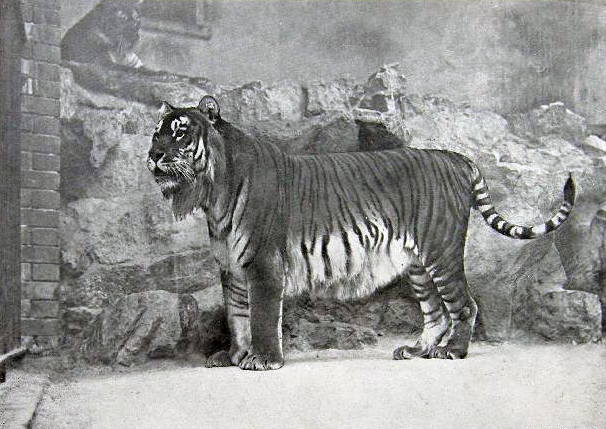
If the Asiatic cheetah becomes extinct, it will join the Caspian tiger which became extinct in the decades past.

It really aggravates me and makes me feel angry to see that these conservationists have become victims of injustice and paranoia that is sweeping across Iran, due to the presence and influence of the Islamic Revolutionary Guard. How can these people be persecuted like animals when they have been working with the country's government and securing permit rights to conduct their operations in the name of conservation, especially when the animals they are studying are on the precipice of extinction? Iran wants to save the Asiatic cheetah, which is teetering on the brink of extinction, but the country's own people, both local and coming from abroad, are being unfairly targeted on flimsy charges relating to espionage when all they are doing is conducting research in order to save the cheetah. And despite the lack of solid evidence against them regarding such allegations, they are still being held hostage. This is absolutely intolerable! I cannot stand this form of senseless injustice being implicated on these innocent people and neither can the world. It is not just conservationists who have been targeted, other people have also fallen victim to this heinous witch-hunt. In the past two months, authorities have arrested two scholars of dual citizenship. They are French-Iranian researcher Fariba Adelkhah and British-Iranian anthropologist Kameel Ahmady. In addition, a U.S scholar from Princeton University named Xiyue Wang has been jailed since 2016 when he traveled to the country to research his thesis on the Qajar dynasty. I strongly urge the government of Iran to take intense action against the Revolutionary Guard, in order to ensure justice for the conservationists and other people held captive in the country on baseless charges. The Revolutionary Guard may be essential to Iran regarding duties such as defending its borders, but its actions has labeled it a terrorist organization by Saudi Arabia, Bahrain, and the United States. Therefore, I believe that it is absolutely essential to bring substantial changes to the Revolutionary Guard by identifying and prosecuting members responsible for arresting innocent scholars, business executives, dual nationals and others, and torturing them on the baseless charges related to espionage. I think that even though Iran wants to save the Asiatic cheetah from extinction, it has inadvertently halted the efforts intended on saving it by having conservationists arrested on such flimsy criminal charges. This cannot and should not happen any further! Any further delay and not only would the conservationists studying the cheetahs succumb to the injustice instilled upon them, but the cat itself would vanish into history just like the Caspian tiger and the Asiatic lion which became extinct in Iran in the decades past.

View article and video here                       

Thursday, August 29, 2019

Shifting Indonesia's Capital to Borneo Must be Approached with Care and Caution

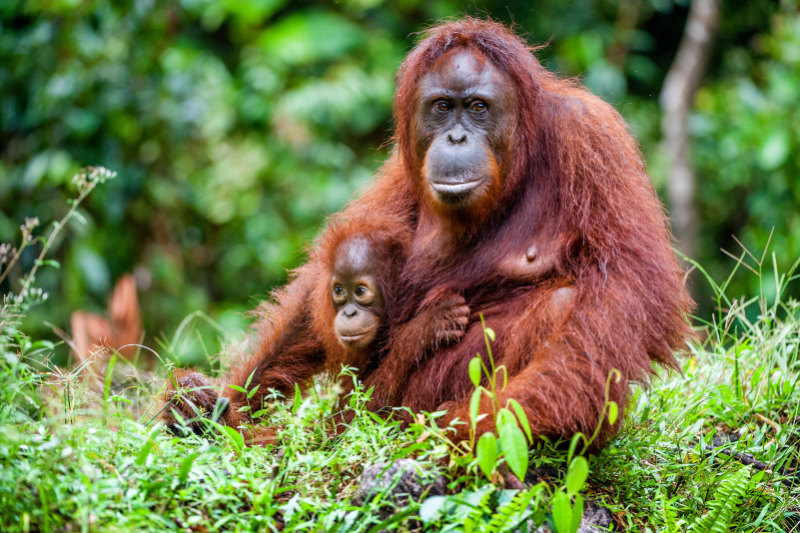
A mother Bornean orangutan with baby

The President of Indonesia, Joko Widodo, recently disclosed that the country's national capital will move to a newly built city on the island of Borneo. On Monday, President Widodo announced that the new capital would be near the city of Balikpapan, where roughly 800,000 people reside. It would be established partly in Penajam Paser Utara Regency and partly in Kutai Kertanegara Regency - both in East Kalimantan province. However, he did not reveal what the name of the new city would be. The new city will join Brasilia, Canberra, and Naypyitaw as planned capital cities, and construction is expected to commence in late 2020. The reason for this shift is because the current capital, Jakarta, is severely polluted, overcrowded, susceptible to flooding, congested by traffic, and is sinking by up to 10 centimeters per year in some places. President Widodo further added that Borneo has fewer natural disasters, it lies right in the center of the country and is located near developed cities like Balikpapan and Samarinda, has adequate infrastructure, and about 180,000 hectares of available government land. He also acknowledged that Jakarta will still be the center of finance, business, trade, and services at national and international level. However, much of Borneo is home to huge areas of forests and endangered species like orangutans and environmental groups will be dissatisfied that some of these forests will be cut down for the establishment of the new capital. They have already declined concerns about the impact the move will have on the environment and wildlife.
Map of Indonesia showing the locations of current capital and new capital

Although I understand the reason for shifting Indonesia's capital, I'm also concerned about the impact of the development can have on the environment and wildlife of Borneo. This island is home to a wide variety of animals, including endangered species, such as Bornean orangutans, elephants, clouded leopards, and proboscis monkeys. Many of these animals have been and continue to be threatened by anthropogenic factors like deforestation, poaching, and wildlife smuggling. Generally speaking, the development of Indonesia's new capital would further affect the survival of the animals unless the approach is proceeded with care and caution. I strongly advise the government of Indonesia that if it intends to shift the country's capital to Borneo from Java, it should be done in an extremely delicate manner so that there is minimal effect on the environment and wildlife. It is highly crucial to consult with environmental and conservation groups, who can help identify which areas contain wildlife and wildlife corridors and which areas do not.
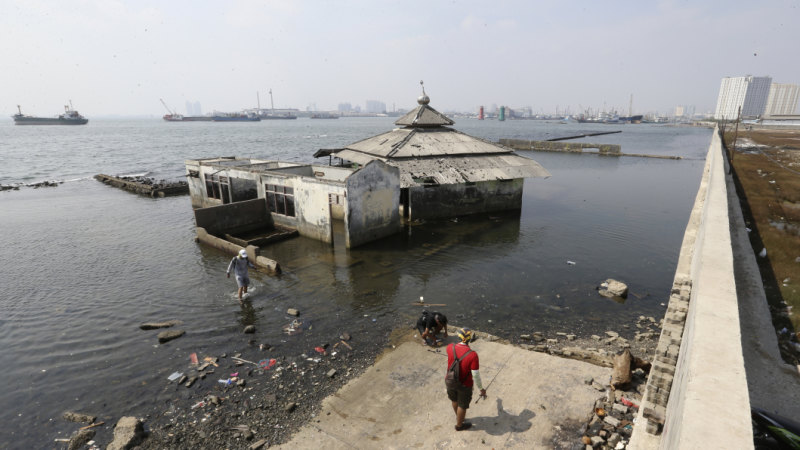
An old mosque lying outside a giant seawall used as a barrier to keep sea water from flooding the city.

While the construction of the new capital is scheduled to begin until late 2020, I really think Indonesia should first focus on mitigating pollution in Jakarta. In recent months, the pollution has become so bad that the city has topped the list of most polluted cities in the world according to the AirVisual website. I also believe that Indonesia needs to tackle the flooding issue in Jakarta. The city is sinking fast because much of the population depends on bore water. In addition, increasing sea levels have placed the northern part of the city, which lies on Jakarta's bay, at higher risk of flooding. Experts at the Bandung Institute of Technology warned that as much as 95 % of north Jakarta could be under water by 2050. This is why it is highly essential to conduct strong, yet effective measurements to minimize the threat of flooding due to rising sea levels and keep the bore water in check.

View article here              

Friday, August 23, 2019

Urgent Action Needed on a Global Scale to Save the Amazon Rainforest!

Satellite image showing fires damaging the Amazon rainforest in Brazil

The Amazon rainforest conjures up an image of a quintessential rainforest. Vast, unknown, and loaded with undiscovered species not known to science in decades past. These are the features that make the Amazon rainforest a paradise for scientists and researchers, whose goal is to study such places in order to ensure they receive significant recognition on a global scale. However, like all rainforests of the world, the Amazon rainforest has been susceptible to deforestation for countless decades. And now recently, that scale of destruction has reached an unprecedented scale with more than 39,000 wildfires that have been devastating the rainforests since January this year. According to Brazil's National Institute for Space Research (INPE), there have been 74,155 fires so far in the Amazon which represents a staggering leap of more than 80% over last year and probably the most that the agency recorded since it started gathering this data in 2013. Roughly half of those fires have flared up last month making it almost as many as in all of 2018. The proliferation of the fires has resulted in darkening of skies over Sao Paulo and other major Brazilian cities. The country's president Jair Bolsonaro has shown apathy about the situation and regularly castigated Brazil's environmental regulations as a hindrance to economic development, and under his term environmental agencies have seen reduction in staff and funding. Among those include the INPE itself, whose leader, Ricardo Magnus Osorio Galvao, was fired this month. According to Galvao, the reason for his discharge was because he suspected how President Bolsonaro was using INPE's data. When asked about the fires by, President Bolsonaro flimsily indicated that nongovernmental organizations have been setting fires as payback for the scaling back of Brazil's normal funding support for them. He hypothesized that these organizations are trying to intensify international pressure on the Brazilian government, but when reporters urged him on the point, he did not name any particular NGOs or give any proof for his assertion. He further added that his government is "not insensitive" to the fires and that it may look into measurements to fight them.
Smoke from fires clouding over Sao Paulo

According to Brazil's environment minister Ricardo Salles, the fires have been associated with "dry weather, wind and heat" and stated that federal officials and equipment are available to help and "already in use." However, the deforestation has more to do with human activities than natural factors. INPE stated that the amount of land deforested last month alone represented an almost 300% growth over deforestation in June 2018. As NPR reported in 2015, deforestation like this is generally connected to subsistence farming and ranching, which is known to use more than two-thirds of Brazil's deforested land and has increased the number of cattle in the past thirsty years. It is estimated that forest areas in the Brazilian Amazon have dwindled between 20 and 30% compared to last year. Fluvio Mascarenhas, who works for an agency called the Chico Mendes Institute for Biodiversity Conservation, indicated that the operations the agency conducts against illegal loggers and ranchers have been extremely scaled back this year. He further added that this, along with President Bolsonaro's comments, bolsters more illegal activity in the rainforest.
Brazilian President Jair Bolsonaro has come under fire regarding his view on the wildfires

I can never think of anything more cataclysmic than the destruction of the Amazon rainforest caused by wildfires this year. The extent of damage caused by the fires and the impact they are having on Brazil and the rest of South America is so indescribable, that one can easily say that urgent action needs to be taken to prevent further damage. However, the devastation does not seem to faze President Jair Bolsonaro, who baselessly claimed that NGOs are responsible for setting the fires in retaliation for scaling back of the Brazilian government's usual funding support for them. To make matters worse, under President Bolsonaro's tenure, the country's environmental agencies, including the INPE which documented the destruction through satellite imagery, saw reduction in staff and funding. How can such agencies be able to take action to prevent further damage from these wildfires without proper funding from the federal government? This cannot go on! I strongly believe that urgent action needs to taken on a global scale to help Brazil combat the fires. This includes providing funds and support for measurements directed at containing these fires and identifying illegal loggers and ranchers, who are behind the deforestation of the Amazon rainforest. Furthermore, efforts need to be taken to root out corruption in Brazil in relation to the country's deforestation issue and identifying political figures associated with it. The wildfire devastation in the Amazon has reached astronomical proportions and is tremendously impacting people's lives in major cities like Sao Paulo, as well as the local wildlife and indigenous populations that call the rainforest home and it is highly essential to take action.

View article here                                          

Wednesday, August 14, 2019

Great Indian Bustard Conservation and Politics Should Not Mix!

Great Indian bustard

In India, conservation of various endangered species are known to be subjected to political influence especially when the species are seen by public as "charismatic" and have a special place in the general mindset of people. For example, the Asiatic lion is widely regarded by many as a representative of Narasimha and is linked to the Lion Capital of Ashoka. However, its conservation is subject to political influence when it comes to translocation outside Gujarat. This is seen when the state governments of Gujarat and Madhya Pradesh are at each others throats with Madhya Pradesh calling for lions to be brought into the state to start its own population and Gujarat arguing that the big cats are part of the state's heritage. But now, there is another endangered species that has become subject to political influence: the great Indian bustard. This was recently seen when Gujarat requested Rajasthan to lend one of its male bustards in an effort to revive its population, which is mostly comprised of six females. Gujarat's decision to make this request comes from when the state's only male bustard went missing last December and the government's hope was lost regarding the male's return in the mating season, which ended in June. The government of Rajasthan, in response, refused to lend one of its male bustards to Gujarat. Principal chief conservator of forests Shyamal Tikadar was told that Gujarat chief minister Vijay Rupani made a proposal at a state wildlife board meeting that Gujarat should get a male bustard from Rajasthan or that female bustards from Gujarat be sent to Rajasthan for breeding. On the other hand, Rajasthan's forest and environment minister Sukhram Bishnoi denied receiving any formal proposal from the Gujarat government and that the state would still refuse such a proposal. Instead, he suggested that Gujarat should capture all six female bustards and send them to Rajasthan for breeding. A senior officer involved with Rajasthan's bustard project added that the state's former BJP government, as well as current Congress government, was reluctant to give its bustard eggs to Gujarat for captive breeding. In addition, because of Rajasthan government's resistance, the captive breeding center which was to be established in Gujarat was shifted to Rajasthan. WII expert Y.V Jhala, who is linked with the captive breeding center, also agreed with the refusal to send a male bustard to Gujarat. However, unlike what Gujarat and Rajasthan governments said, Dr. Jhala indicated that Gujarat has not addressed the issue of overhead high-tension power lines in bustard habitat and called for the state to move all power lines underground or sending a male bustard will not serve any purpose.
A great Indian bustard in flight

It really frustrates me that the conservation of a critically endangered species like the great Indian bustard has become subjected to political influence. This majestic bird is on the precipice of extinction and little has been done to save it, let alone an establishment of a captive breeding center in Rajasthan. Even though officials of the Gujarat Forest Department proposed to move high-tension power lines underground, the state government has been negligent and nothing has been done. Even with no male bustard left in Gujarat, the government has not addressed the issue. This has got to change! I strongly urge the government of Gujarat to take decisive action in preventing any further depletion in the state's bustard population. This means either moving all power lines underground or transferring the female bustards to Rajasthan for captive breeding. While I strongly agree that major conservation efforts require political will, it should not go to the extent where two or more state governments constantly argue with one another or make up excuses on political grounds regarding the plight of an endangered species in focus. This especially applies to the great Indian bustard and other species that are on the brink of extinction. Although the government of Rajasthan indicated that it has established a captive breeding center for the bustards as a reason to why it is reluctant to hand over one of the male birds to Gujarat, I'm guessing there could be other reasons as well. One of the reasons being that the bustard is Rajasthan's state bird and is therefore part of the state's heritage. This is similar to the argument Gujarat government made regarding the translocation of lions outside the state. But as long as governments of Gujarat and Rajasthan continue to be at each others throats over the conservation of bustards this way, these majestic birds will keep dwindling until they vanish into history. This is why I strongly urge both the governments to please refrain from arguing with one another and focus on providing support to conservation efforts to save the great Indian bustard, such as captive breeding and moving power lines underground. This especially applies to the government of Gujarat, which has not done anything to help save the bustard in the state. The clock is ticking and there is absolutely no room for negligence!

View article here          

Tuesday, August 13, 2019

Has South Africa Become Unsafe for Lions?

A family posing with a lioness shot during a canned trophy hunt

South Africa
, like other African countries, is home to some of the most spectacular wildlife that draws thousands of tourists each year to see. Among the wildlife which tourists come to see are lions. But unlike other countries, tourists in South Africa not only get to see lions in its national parks and game reserves; they also get to see lions in enclosures located in the outskirts of various towns and cities. Usually, tourists either take pictures of lions from behind the chain-link fences or have pictures taken with the cubs. But what tourists don't know is that these captive-bred lions are subject to the brutal and bloodthirsty sport of canned hunting in South Africa. The most recent proof of the brutality of South Africa's canned hunting industry was seen in July when officials investigating a lion breeding facility called Pienka Farm in the North West Province uncovered a myriad of horrors linked to the blood sport. The first example was captured on video in which two cubs were locked in separate crates showing severe neurological issues as their heads shook uncontrollably. The cubs' fore and hind legs were paralyzed and displayed other serious injuries, which forced the veterinarian to euthanize them at the scene. In addition, the investigators also discovered bodies of about twenty lion and tiger cubs crammed inside a chest freezer.
One of many dead lion cubs found inside a canned hunting facility during an investigation in July

This was not the first time investigators discovered serious animal welfare issues at the farm. In April, officers from the National Society for the Prevention of Cruelty to Animals (NSPCA) visited the facility and found dozens of lions and tigers cramped together in small cages with no water or shelter. 27 animals were suffering from extreme mange and the caracals were so overweight they could not lick themselves clean. The visit also revealed that more cubs suffered from serious neurological conditions. Although animal welfare charges were laid, no action had been taken since then, as officials are reportedly still collecting evidence. Further charges will be added after the second investigation. Pienka Farm is one of an estimated 300 lion breeding facilities in South Africa, where big cats are merely bred for exploitation. Many are subjected to canned hunting after being used and abused throughout every stage of their lives. Eventually, the big cats are harvested for the lion bone trade. An advocacy group called Campaign to Ban Trophy Hunting notified The Sun of this heartbreaking case, bringing the issue of South Africa's captive lion breeding into the media spotlight.
A freezer chest containing several dead lion cubs

It really aggravates me to the core that a country like South Africa, which attracts thousands of tourists each year, has turned into a hell on earth for majestic animals like lions. Not only do these animals live in protected areas, but they also live on these facilities where tourists are given an opportunity to pet them, bottle-feed them, and then ultimately shoot them in an enclosed space for trophy. Even worse is that the practice of canned hunting which these lions are subjected to is legal and is thriving. The Born Free Foundation has estimated that more than 8,000 lions and big cats are held in hundreds of such facilities across the country. These animals are separated from their mothers when they are 2-3 weeks old and their mothers are immediately forced to breed again in a convoluted cycle. The cubs are petted and bottle-fed by naive tourists who pay to volunteer at these so-called "orphanages", maliciously assuming that their efforts are contributing to the conservation of lions. The cubs are then manipulated at lion-walking facilities, where tourists spend money to get their selfies and other pictures taken. Ultimately, the cubs are sold to canned hunting facilities as adults. Due to their continuous existence with people, the animals lack fight-or-flight response which allows clients to shoot them in cold blood and pose for pictures. After being ruthlessly slaughtered in the name of sport, the animals' body parts and bones are sold to dealers in Asia who make medicine out of them. Approximately 800 "farmed" lions are mercilessly killed by trophy hunters each year in South Africa. This has to got to change!
Several emaciated lion cubs showing extreme mange as a result of neglect and abuse

I strongly urge the government of South Africa to take strong measurements in targeting such facilities that provide such false services to tourists into thinking that they are doing "good" for the conservation of lions. Instead, they are breeding lions in captivity to be ruthlessly slaughtered in the hands of brainless tourists who pay large sums of money to experience the "thrill of the chase" in hunting these lions in an enclosed area. What is even more upsetting is that the money tourists pay often goes to major conservation organizations as funding for projects that ensure the survival and protection of lions as a whole. I firmly believe that tourists, especially foreign ones, should be thoroughly educated about the grim reality behind South Africa's lion breeding facilities. If these tourists really love lions and care about them, then they should not visit these kinds of places. Instead, they should visit reputable facilities that not only house lions and other animals from neglect and abuse by people but also live up to the creed of conservation by ensuring the animals are well cared for and provided with essential amenities like proper food, water, and medical care. However, there are some tourists who simply want to go to South Africa to hunt lions and pose for pictures to show off to their trophies. Ever since the death of Cecil the lion in Zimbabwe four years ago, trophy hunting of lions and other majestic animals came under the public spotlight with many people expressing outrage and contempt towards the practice and those involved. However, that has not stopped some people from participating in such activities. These tourists do not care if an animal is endangered or not. They simply want to hunt an animal such as a lion and want to feel the adrenaline rush that comes with it. These are the people that need to be seriously dealt with, along with operators of various canned hunting facilities.

View article here                

Friday, July 26, 2019

Are Sharks Running Out of Space to Avoid Conflicts with People Fishing?

A shark being pulled up from a boat for sale in Chennai.

A recent study published in the journal Nature has shown that sharks often like to hang around areas that get visited regularly by industrial fishing ships, putting them in serious danger of being caught either as food or as bycatch. As part of the study, researchers outlined the activity of 23 shark species and fishing vessels around the world. They tracked more than 1,500 sharks with satellite tags and linked that data with information on ship movements obtained from safety technology that vessels use to prevent collisions at sea. According to Dr. David Sims, a marine ecologist at the Marine Biological Association in Plymouth and University of Southampton, industrialized fisheries are catching tens of millions of sharks in areas where there is little or no management resulting in some population declines. He further added that sharks have been targeted intentionally in recent decades because the value of their meat, especially their fins, has increased. In addition, sharks are also caught accidentally due to long lines of fishing vessels that can stretch for miles and have more than 1,000 hooks. Researchers did not have a sense of sharks' favorite haunts, where they might be most at risk from the pressure of industrial since the animals travel vast distances across the ocean. Dr. Sims stated that in order to understand where the sharks were hanging out, a global team was established over three years ago. The team comprised of over 150 shark experts who have all worked jointly and cooperated to combine their data into a vast database. The database contains satellite tracks of large species like whale sharks, great whites, and shortfin makos. The experts discovered that sharks usually like swimming along boundaries of different types of water masses, such as one spot in the North Atlantic where warm waters of the Gulf Stream concentrate with colder waters in the Labrador Current. The team then looked at data from Global Fishing Watch, which contained information on tens of thousands of vessels anti-collision technology known as automatic identification system, which allows ships to basically announce their location, course and speed. In general, about 24% of the space used by sharks in a typical month overlapped with long-line fisheries. Of the sharks, blue sharks in the North Atlantic were found to use 76% of space in an average month which overlapped with long-line fishing, while shortfin mako sharks used 62% of space. Dr. Sims pointed out that based on the findings, there are very few safe refuges for sharks and noted that currently, "fishing for sharks on the high seas generally has little or no management for the majority of species." Dr. Elliot Hazen, a research ecologist with NOAA's Southwest Fisheries Science Center in Monterey, California, stated that the overlaps present a possible opportunity and a possible difficulty for conservation efforts. That is, when it comes to managing highly migratory species, there would be a settlement where decision-makers have to decide what is more important: conservation efforts or the economic benefits of the fishing opportunity.

I think based on the findings of this study, it is highly crucial to take concerted measurements in preventing sharks from being caught either accidentally or intentionally. These animals are running out of space which they occupy to stay safe from industrialized fishing and this is seen when the space they occupy overlaps with long-line fisheries. I strongly believe that awareness programs should be established and implemented about using harmless alternatives to long-line fishing, which puts sharks in grave danger of being accidentally caught. Furthermore, fisheries and their personnel should be given monthly updates about where sharks are frequenting so that they don't accidentally catch them while fishing. It is very important to identify and make note of fisheries that purposefully catch sharks for food, especially when those fisheries happen to be from China or any country where the demand of shark fin soup is high. These are the fisheries that need to be targeted and its personnel should be prosecuted under full extent of the law. Sharks normally avoid conflicts with people, but when people venture into their habitats, that is when conflicts arise resulting in serious injuries or death on both sides. This is why it is highly essential to conduct efforts in mitigating human-shark conflicts both on beaches and in the open sea, in order to save lives of sharks and people.

View article here                   

Friday, July 19, 2019

Can Nitrogen Have a Devastating Effect on Coral Reefs?

A diver swimming over elkhorn coral in the Florida Keys

When most people think of climate change devastating the world's coral reefs, the first thing that comes to their mind is the increase in water temperature that contributes to coral bleaching. However, there are other factors that affect coral reefs as well. One of those factors is nitrogen. This was recently discovered in the research of Brian Lapointe, a professor at Harbor Branch Oceanographic Institute in Florida Atlantic University, who had been studying corals at the Looe Key Reef in the Florida Keys National Marine Sanctuary since the 1980s. Dr. Lapointe initially thought that his study would show that rising temperatures were decimating the corals, but instead, his data indicated that nitrogen is the source of destruction. It has been found that increase in nitrogen from crudely treated sewage, along with fertilizer and topsoil from farms and yards, is messing up the quality of water in the coral habitat. Excessive nitrogen feeds algae blooms that obstruct light and throws off nutrient balance in the water in ways that disturbs the coral's life cycle. According to Dr. Lapointe, since the nitrogen has gone up, it has not been balanced by a similar increase in phosphorus which the corals need to grow. This imbalance is refraining the corals of phosphorus. He further added that the imbalance makes the corals unhealthy, and more prone to disease and coral bleaching. According to James W. Porter, emeritus ecology professor at the University of Georgia and co-author of a recently published paper by Dr. Lapointe, the new study indicates that water quality and not just temperature are essential for coral survival. This is seen as coral die-offs occurred long before high water temperatures reach the reef. Dr. Porter further added that the research shows that coral reefs can be protected by taking care of nutrients on the reef and runoff from the land. Furthermore, the findings not only apply to the corals of the Florida Keys, but around the world, including the Great Barrier Reef, which is known to receive runoff from Queensland's sugarcane fields. The authors of the study stated that improved sewage and storm-water management can mitigate nitrogen pollution.
A dying brain coral in Looe Key

I think it is very important to take note of this latest research, which shows that there are several factors that contribute to the devastation of coral reefs around the world. One of those factors is nitrogen, which affects the reefs when entering the waters in large quantities from sewage, fertilizers, and topsoil from farms and yards. In the process, the nitrogen fuels algae blooms that block light from reaching the corals thus resulting in nutrient imbalance that disturbs the corals' life cycle making them susceptible to disease and coral bleaching. I strongly believe that concerted efforts need to be made on a global scale to prevent any further devastation of the world's coral reefs. This includes properly managing sewage and fertilizers to minimize nitrogen pollution. In addition, emphasis need to be put on mitigating runoffs from mainland and into the seas. One example of a coral reef success story was seen in 2011 when the coral reefs of Bonaire in the Caribbean began to recover after a new sewage treatment plant opened that year. I really think that people should look at such examples and learn from them, in order help save the world's coral reefs. Many of these reefs provide food, shelter, and other amenities to the marine life and without them, marine life would be decimated.

View article here