Thursday, November 6, 2014

Tennis Player Andy Murray Becomes Global Ambassador for the World Wildlife Fund

Andy Murray posing with two sniffer dogs.

It has recently been reported that tennis player and 2013 Wimbledon champion Andy Murray has become a global ambassador for the World Wildlife Fund (WWF). In order to show his support to the battle against poaching and the illegal wildlife trade, he will be helping to increase awareness through a Nepal-based initiative that trains dogs to track down poachers and poaching activities in Chitwan National Park. A well-known lover of dogs, Mr. Murray will also be raising crucial funds during the whole of his next year's tennis tour to support this necessary work. The reason is because Nepal boasts with some of the world's most iconic species of animals such as elephants, rhinos, and tigers which are under tremendous threat of poaching for their body parts. In addition, Nepal has also been a basic transport route for products made from the body parts of its endangered species. The country's sniffer-dog training program's main goal is to stop poachers smuggling such illicit merchandise out of Chitwan National Park. This particular program will work with WWF's current wildlife trade program in Nepal. It is even said that a new puppy, who will be part of the first-class training team, will be named "Murray" in honor of Mr. Murray's support.
Andy Murray posing with customs officials over confiscated wildlife products.

It is amazing and beneficial to see how various celebrities are showing their concern and support for the world's environmental catastrophes. Andy Murray is one of the recent celebrities to become an ambassador for the World Wildlife Fund. Other celebrities include Leonardo DiCaprio, Ethan Suplee, Sophia Bush, Jared Leto, and Dick Van Dyke. However, while the following ambassadors and supporters of the World Wildlife Fund are film celebrities, it seems that Mr. Murray must be the first sports celebrity to become the organization's ambassador. He will be giving his support by donating funds during his tennis tour next year and also help raise awareness through a program that trains sniffer dogs to stop poaching activities. The use of dogs in the battle against poaching and the illegal wildlife trade has shown to be as effective as fighting regular crime. These animals help in uncovering products made from the body parts of endangered species and eventually leading to the apprehension of individuals involved in or suspected of being involved in poaching and the illegal wildlife trade. One example of this method has been seen in India's Kaziranga National Park. Now, Nepal has joined forces with India and other countries to anticipate any poaching activities with sniffer dogs. The fact that Andy Murray has joined a long line of notable figures either in sports or entertainment industry should be taken as an inspiration that regular people should also join forces with organizations like WWF to help end poaching and the illegal wildlife trade. Many people around the world who watch celebrities on television or any media sources admire them for their looks and career, and often wish if they could be like them. However, they should also understand that such celebrities are ambassadors and supporters of issues concerning the environment, health, animal rights, and other subjects and should feel inspired to follow their examples in helping make a difference to the world.

View article here      

Tuesday, November 4, 2014

Ministry of Environment and Forests Destroys Illegal Wildlife Products

Environment and Forests Minister Prakash Javadekar with a confiscated leopard skin ready to be burned.

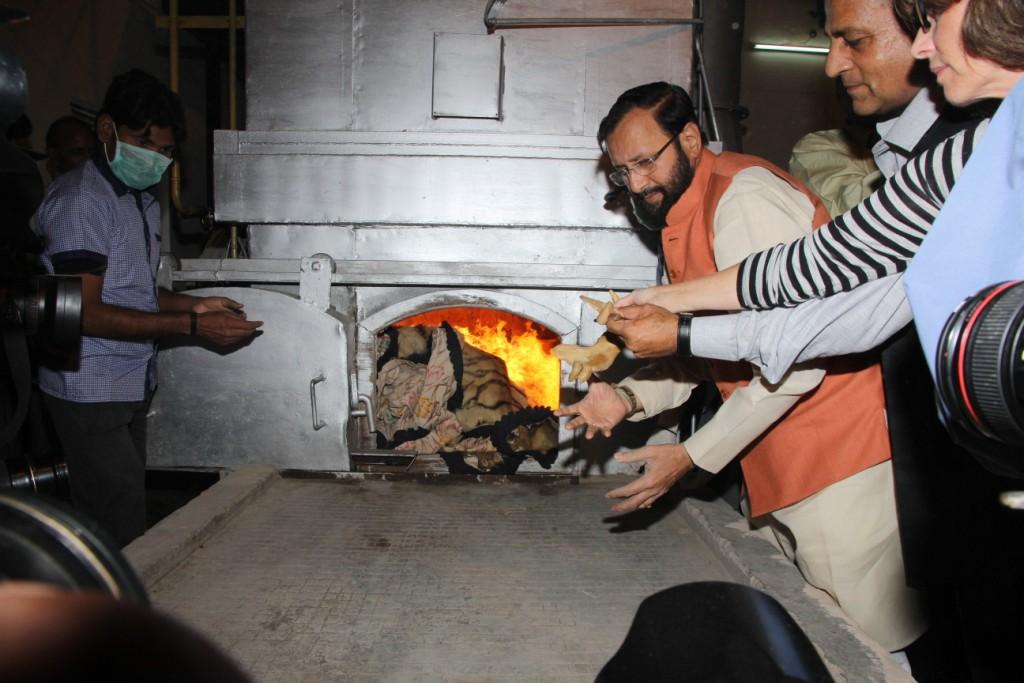
The Ministry of Environment and Forests (MoEF) has recently destroyed a large number of confiscated illegal wildlife products, in order to maintain its intolerance towards the illegal trade of such merchandise. The products, which derived from animals such as deer, elephants, leopards, lions, mongooses, owls, snakes, and tigers, were smashed and burned by MoEF officials at the Delhi Zoo. These illicit products resulting from lawless activities in India were confiscated by the Wildlife Department of Delhi in an effort to combat wildlife crimes. In addition, few wildlife products at the Delhi Zoo were also destroyed. According to Minister of Environment and Forests Prakash Javadekar, the money produced from the illegal wildlife trade is being used for global crimes like terrorism and drug trafficking and indicated that the government is dedicated towards the protection of India's fauna and flora. He further added that the practice of hunting occurred 200 years ago and resulted in a situation where several species of animals became endangered and the verge of extinction.
Minister Prakash Javadekar and other MoEF officials burning illegal wildlife products in the Delhi Zoo.

This action committed by the MoEF sends a clear and distinct message that India cannot and will not tolerate the illegal wildlife trade which continues to threaten the world's endangered species. This lucrative, yet illicit business is connected to other global crimes like illegal drug trafficking, arms trafficking, human trafficking, and even terrorism. That is, the money generated from the illegal wildlife trade is used for carrying out criminal activities that endanger human lives. In other words, terrorism and other global crimes that threaten human beings are intertwined with poaching and the illegal wildlife trade. This is why it is essential to understand this connection so that the world can come together to put a stop to crimes directed at both humans and animals. When admitting that money made from the illegal wildlife trade is used for conducting crimes against humans, Minister Javadekar gave an example of how a single rhino horn can produce Rs. 10 million which can be used for terrorism or drug trafficking. Another classic example is seen in the case of elephant ivory which is used to finance Africa's militant groups such as the Al-Shabaab, Janjaweed, and the Lord's Resistance Army (LRA). In Malaysia, there are fewer than 350 tigers left as a result of poaching and the money generated from the products derived from these big cats could be used for trafficking drugs, weapons, and humans or even terrorism. Therefore, it is essential that countries around the world, including those that serve as major hubs for poaching and the illegal wildlife trade, to band together in order to put a stop to wildlife crimes in order to not only save endangered species but also human beings.

View article here  

Sunday, November 2, 2014

Iberian Lynx to be Reintroduced in Portugal

Iberian lynx

It has recently been reported that a deal was signed last week between the Institute for Forest and Nature Conservation (ICNF) and land-owners in order to secure 2,000 hectares of scrubland habitat in Portugal to help reintroduce the critically endangered Iberian lynx. The signing was made on Thursday last week at a ceremony, which was supervised by the country's Secretary of State for Spatial Planning and Nature Conservation Miguel de Castro Neto. He indicated that the deal was a "decisive step in the breeding and conservation project, initiating geographical information, with close collaboration between the owners and managers of the place where the lynx will be reintroduced." The proprietors have shown their willingness in helping the lynx on their land which coincides with the animal's natural habitat. In addition, they can also hope to see their properties increase in economic value through their association with the project. As part of the efforts to bring the Iberian lynx back from extinction, there is even a project called SOS Wild Rabbit which has also been favored by State Secretary Miguel de Castro Neto. This conservation project, which is funded by the Nature Conservation Fund, is designed to find ways to maintain the populations of the European rabbit which is the lynx's main source of prey. One of the main causes for decline in Iberian lynx populations is the sudden drop in the European rabbit population due to disease, habitat loss, and land development.

It is amazing to see that the Iberian lynx is being given a second chance with a promise of reintroduction in Portugal. This magnificent cat once ranged throughout Portugal and Spain before being restricted to only few parts of the Iberian Peninsula. However, with the signing of a deal last week between the ICNF and local landowners, the lynx is now ready to make a comeback to its historical range in Portugal. What makes this deal unique is that it indicates a joint collaboration between conservationists and local people to help ensure the survival of the lynx in Portugal where it once disappeared. Hopefully, this step would also help in the long-run for the Iberian lynx. It has been and continues to be threatened by a variety of issues ranging from land development to habitat loss, poaching, and even disease. In addition, the lynx's major prey source, the European rabbit, also faces the same threats. When one species suffers in the hands of humans, another species is also affected. This is why it is crucial to help both the Iberian lynx and the European rabbit in order to prevent either one from being severely decimated in the unlawful hands of people. Furthermore, it is essential to combat the disease that is devastating the European rabbit population in Portugal and Spain. If the European rabbit population continues to decline, then the Iberian lynx population would also be depleted dramatically and the scrubland ecosystem which these two species are part of would be deeply affected negatively.

View article here  

Sunday, October 26, 2014

Mobile Phones Helping Save Lives of People from Indian Elephant Encounters

Indian elephants in tea fields

It has recently been reported that mobile phones are being used at an increasing rate in the Indian state of Tamil Nadu to cut down the conflict between elephants and people living near their habitat. Leading in this technological revolution is Ananda Kumar of the Nature Conservation Foundation (NCF), who pointed out that elephants have killed as many as 39 people from 1993 to 2013. He further added that 30 of those deaths occurred as a result of people not being aware of the elephants' presence. Initially, in 2002, Dr. Kumar and the NCF used a local cable network to warn the local villagers about the elephants' presence which led to two tribal watchers being hired to track the animals in a hill station called Valparai. The location where the elephants were sighted was recorded and shown on Valparai Television (VTV) through a news ticker at the bottom of the television screen. However, the strategy of using the cable television began to lose its purpose which prompted Dr. Kumar to employ mobile technology. He began sending out mass text alerts to subscribers to warn them of the elephants and eventually the number of subscribers increased. In addition, Dr. Kumar and his team also helped set up beacons to alert people during late evening hours when elephants move through tea estates. The way this works is when an elephant or a herd of elephants are in the vicinity, a call or text message sent either by NCF or anonymous villagers would turn on the beacons which give off a blinking red light to warn people moving around at night. Furthermore, Dr. Kumar and his team also maintains a comprehensive database of each subscriber and place of residence for over 2,000 people and prepares maps that recognize numerous corridors through which elephants move. This is also covered with maps of villages to analyze areas that are most sensitive to encounters with elephants. The hard work implemented by Dr. Kumar and the NCF has paid off. Between 2002 and 2007, there were no incidences of human deaths from elephant encounters for 31 months. In addition, property damage by elephants decreased significantly in 2011 and 2013. The advantage of Dr. Kumar's work is that interventions are maintained by the community and based on considerable conversations with them using current technology that is easily managed. The program is financed by a U.K-based charity called Elephant Family and some local tea plantations.
An elephant caught on a rampage in Karnataka

The measurements conducted by Dr. Kumar and the NCF are shining examples of how to take necessary steps to prevent any fatal encounters between people and animals and ensure peace and harmony between the two species. Human-wildlife conflict is a growing problem in India with accelerated urbanization and clearing of land. A recent report by the National Crime Records Bureau (NCRB) indicated that almost 1,000 people were killed in Assam, Maharashtra, and Orissa in conflicts with wild animals between 2009 and 2011. Among the animals that were known to kill people were elephants. However, in Tamil Nadu's Valparai Hill Station, there is a stark contrast to the ongoing fatal encounters between people and animals due to the extraordinary work put by Dr. Kumar and the NCF thanks to the use of advanced technology and extensive communication with local villagers. One example of this outstanding achievement occurred when Dr. Kumar received a call from a village woman in the middle of the night after she saw an elephant outside her house and was worried that her one-month old child's crying might excite the animal. In response, Dr. Kumar encouraged the woman to keep making noise to show that there are people inside and advised her not to go out in the middle of the night. In the meantime, a range officer arrived at the spot to help her and the elephant went away. The following morning, the woman called Dr. Kumar and thanked her him for saving her child. This just one of the few success stories in which people and animals are able to coexist peacefully. However, elsewhere in India there are numerous incidents of human-wildlife conflicts resulting in human and animal deaths as the country continues lose 300 acres of forests and other habitats per day to roads, highways, and mining. With so much shrinking of habitat, it is very crucial that Dr. Kumar's conservation model needs to be simulated in other parts of India where the human-wildlife conflict remains high. Hopefully, this conservation model will also help in curbing similar situations outside India in other places like Africa, Southeast Asia, Sri Lanka, etc.

View article here         

Thursday, October 23, 2014

Experts- Increase in Indus River Dolphin Population

Indus river dolphin

Experts have recently indicated that the population of the Indus river dolphin is increasing, despite being confronted by threats such as addition of poisonous chemicals in water, illegal fishing, industrial waste, and sewage. A survey conducted in 2011 revealed that the number of dolphins occupying the Indus River between the Chashma and Kotri Barrages was 1,505. According to the World Wildlife Fund's senior project officer in Sukkur Imran Malik, the dolphins ended up towards Kotri Barrage during a powerful flood in 2010 and became vulnerable to slipping into the barrage's offshoot when searching for food during the yearly closure of canals every January. He further added that fishermen dumped poisonous chemicals into the river after the floods eased off, which resulted in considerable damage to the dolphins and other marine life. Since then, the World Wildlife Fund joined forces with the provincial wildlife and fisheries departments to establish an awareness campaign in that regard. In addition, he indicated that there are currently 1,452 dolphins in the river, out of which 96 were documented in between the Chashma and Taunsa Barrages, 465 between the Guddu and Taunsa Barrages, 857 between the Guddu and Sukkur Barrages, and 34 between the Kotri and Sukkur Barrages. According to the deputy conservator of Sukkur's wildlife department Taj Mohammed Shaikh, the reason the dolphin population has increased is due to the ongoing awareness campaign which helped people learn about the significance of marine life. Therefore, there had been no reported incidents of poisonous chemicals being added into the river or canals in the last two to three years.

Although this seems like promising news for the river dolphins in the Indus River ecosystem, this does not mean they should be safe from human activities on the long-run. There are still threats of sewage being released into the waters by people residing along riverbanks, chemicals for fishing being added into the river, hot water released from the Guddu thermal power station, and industrial waste dumped by factories in Sukkur and Ghotki District. This has led to the range between the Guddu and Sukkur Barrages being declared a protected area to protect the river dolphins. However, there are probably other areas between Pakistan's barrages where dolphins may be residing in considerable numbers. Therefore, is why it is extremely crucial to work in order to prevent the dolphins from becoming extinct. This does not only mean setting up an awareness campaign, but also establishing special treatment plants to remove any harmful material from sewage before being released into the river. Similar facilities should also be set up to treat industrial waste being produced from factories. Furthermore, a ban should be imposed on chemicals used for fishing and the policy for issuing fishing licenses must be reviewed. It is important to understand that awareness campaigns alone cannot guarantee the survival of an endangered species; there should also be an implementation of direct action towards any factors deemed as threats to that endangered species. For example, in the case of Indus river dolphins, the threat of pollution should be dealt with the establishment of treatment plants specializing in treating sewage and industrial waste in order to prevent the dolphins and other marine life from being severely harmed. The combination of awareness campaign and direct action can promise safety and survival of endangered species.

View article here   

Sunday, October 12, 2014

Ministry of Environment and Forests Approves Electronic Inspection Near Railway Lines to Counter Elephant-Train Collisions

A herd of Indian elephants

The Ministry of Environment and Forests (MoEF) has recently approved the use of technology, specifically 24/7 electronic surveillance and wireless sensors, to end high numbers of elephant fatalities due to train collisions. The use of electronic surveillance and wireless sensors is a new addition to a series of measurements such as reducing speed of trains in areas haunted by elephants that the MoEF has identified to protect them and also save them from train collisions. The MoEF had also notified the Supreme Court about these new measures in an affidavit filed last week where a case is being conducted on the issue. In addition, the ministry has also notified the apex court about ratifying site-specific solutions instead of enforcing systematic measures for the entire elephant landscape which is extended across sixteen Indian states covering nearly half of India. These states include Odisha and West Bengal where the problem of elephant deaths by train collisions is quite dangerous. The Supreme Court has over the years showed concerns over the elephants' deaths after being killed by speeding trains, and even requested the railway and environment ministries to take concerted measurements to stop the danger.

The MoEF is now fighting for the use of electronic surveillance to keep a note on such deaths. In its affidavit, it notified the court about a pilot project by the Indian Institute of Technology (IIT) Delhi for an economical wild animal detection system that uses wireless sensor systems at Uttarakhand's Rajaji National Park. The ministry had earlier set up the "e-eye" system based based on infra-red cameras on pilot basis in Corbett National Park for following wild animals and catching poachers. Now, it has told the government of West Bengal to check out the usefulness of implementing the "e-eye" in the state's northern landscape. The affidavit also disclosed that the MoEF and railways have agreed on restricting the train speed to 25 kilometers per hour in all recognized elephant habitats. The ministry also proposed diverting goods and unscheduled trains from other routes in elephant areas recognized in West Bengal. Other measurements suggested included easement of lofty slopes on railway hills in all elephant areas, planning barriers and fencing in vulnerable expanses of railway tracks, stimulating railway staff, and constructing ramps and underpasses in areas frequented by elephants to expedite smooth movement of the animals.

The approval given by the MoEF in using electronic surveillance and wireless sensors shows that elephants can safely cross railway tracks with little or no fear of being killed by oncoming trains. This also shows that the railway ministry would not have to face any further problems regarding damage to the trains as a result of elephant-train collisions. Reducing speed limit of trains is not enough to put an end to the growing problem of elephant-train collisions. Solutions such as constructing ramps and underpasses, establishing barricades and fencing in vulnerable areas of railway tracks, sensitizing railway staff, and diverting trains from other routes are also essential in further maximizing the safety and protection of elephants from train collisions. These measurements would not only help save elephants, but also other animals that share the same habitats with elephants in areas dissected by railway tracks. However, elephants are not the only animals in India at risk of being killed by trains. There have been reports of lions getting killed by trains either in the vicinity or outside Gir Forest National Park. It would also be beneficial to implement the same measurements being proposed to help save the elephants from getting hit by trains in order to ensure the safety and well-being of lions.

View article here 

Saturday, October 11, 2014

U.N Helps South Africa Battle Rhino-poaching Through Donation into Law Enforcement and DNA testing

Black rhinoceros

The United Nations has recently donated R30-million into law enforcement and DNA testing to help South Africa battle the ongoing poaching of rhinos. Environment Minister Edna Molewa indicated at a briefing that her department had signed a cooperation agreement with the United Nations Environmental Programme (UNEP) to establish the program. The United Nations' Global Environmental Facility (GEF) has allotted R30-million to the project over four years. This project, known as the UNEP-GEF Rhino Project, is devised to intensify law enforcement, improvise environmental crime scene management, and help stop poaching on the ground and the illegal wildlife trade internationally. One of the main focuses of the project will be the application of forensic technology to help assure convictions for the poaching and trade of rhino horns. Part of this project would include enhancing a database of rhino horn DNA samples. That is, several rhino horn stockpiles that were built up over the years from natural causes of death had DNA samples taken. Some of these horns were analyzed by the veterinary genetics laboratory from the University of Pretoria. However, there was an inventory of samples to be evaluated and the money donated by the GEF would help pay for the inventory to be reduced. Minister Molewa stated that the DNA analyses provided a record of the horn's origin, which, if found wrongly in possession of anyone, would help in prosecuting the individual. According to Frances Craige, chief director of South Africa's Department of Environmental Affairs, the money would be used for crime scene management such as how and when a rhino was killed. Earlier, a program manager had been assigned to supervise the UNEP-GEF Rhino Project and a trailer containing forensic equipment was bought. A training on advanced crime scene management is scheduled to begin next month.

It is very beneficial and helpful of the United Nations to help South Africa in its battle against rhino-poaching. The money donated by the U.N will help South Africa strengthen its law enforcement, conduct DNA testing, improvise environmental crime scene management, and stop poaching and the illegal wildlife trade on both national and international grounds. All these goals are part of the UNEP-GEF Rhino Project. This project has so far consisted of a program manager to run it and a trailer containing forensic equipment has been bought, but there is still a host of other components to help in the fight against South Africa's rhino-poaching problem. One of them is the training of advanced crime scene management which will start next month. In addition, this project has also brought together other groups involved in the rhino-poaching battle. These include South African National Parks (SANParks), the South African Police (SAP), University of Pretoria, and the World Wildlife Fund (WWF). It appears that South Africa is on the verge of gaining the upper-hand against the poaching of rhinos with this project underway. Hopefully, this will prevent poachers from further decimating South Africa's rhino population to meet the growing demands of rhino horns and save the nation's tourism industry.

View article here