Friday, June 24, 2011
Studying Abroad in Tanzania
Hey everybody. Sorry I have not been keeping you all updated with any news on wildlife and conservation all this time. I had been attending a study abroad program in Tanzania. This program allows students to actively participate in activities related to wildlife management in national parks like Lake Manyara, Tarangire, Ngorongoro Crater, and of course the Serengeti. This program is one of many provided by the SFS (School for Field Studies). During my stay, I had been traveling with other students to these remote and exotic places and seeing some of the most amazing wildlife in the world. In addition to that, I have also been experiencing the Tanzanian culture by interacting with the local people, including the Masai. I will be returning on July 5th, and keep everyone updated on any such news.


Saturday, May 21, 2011
China Fails in its Commitment to Save Tigers
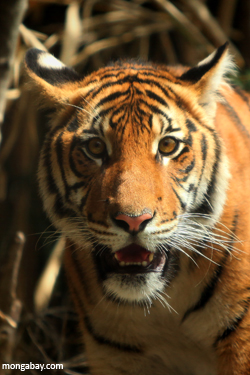 |
| A Malaysian tiger |
The Environmental Investigation Agency (EIA) has recently stated that China has fallen short of commitments in tiger protection. The agency has also written a letter to Premier Wen Jiabao expressing concern over China's State Forestry Administration's handling of tiger protection. Jiabao had initially made a pledge during a Global Tiger Forum held in St. Petersburg last fall that China would vow to work with other Asian nations to end the global trade of tiger parts. But during a series of meetings on the illegal wildlife trade held in March, it was pointed out that a representative of China's law enforcement was unaware of any arrests or prosecutions related to the tiger trade or even the seizures of tiger products since the forum. EIA also showed that China relies heavily on NGO-generated intelligence to keep track of the illegal trade in tiger parts.
In addition to commitment, the agency also revealed that the nation lacks the capacity to address its promise to increase its tiger population within its borders and end the trade in tiger parts. According to EIA, the capacity is further combined by the Chinese policy which undermines the nation's commitments to its tiger protections. The agency recommends that China should establish a zero tolerance policy for the trade in tiger parts, and further forbid all such illegal activities. EIA even encouraged Premier Jiabao to give responsibility to a full-time unit of police officers for crimes in the wildlife trade, and work to intensify the capability of the State Forestry Administration to respond to wildlife crimes. throughout the nation.
I'm very much shocked and surprised to hear these news about China's role in the tiger protection. Earlier before the Global Tiger Forum, China had made a vow to help put an end to the illegal trafficking of tiger parts. These include signing a memorandum of understanding (MOU) with India, and working with it to curb such illegal activities. However, as early as 2007, China had adopted an agenda which would allow the sale of tiger skins of "legal origin" which violates its commitments under the Convention on the International Trade in Endangered Species (CITES). These commitments state that tigers should not be farmed like livestock for their body parts. I'm very proud to see what flaws the EIA has revealed in China's position in the world's tiger protection, and very much agree with its recommendations. If China wants to help save the world's tigers, it should rely on more than just NGO-generated intelligence.
View article here
Friday, May 13, 2011
Anti-Poaching Efforts to Protect Tibetan Antelopes Announced
 |
| Tibetan antelope in its natural habitat |
It has been recently reported that four nature reserves covering 550,000 square kilometers of western China will be joining forces together to protect highly endangered Tibetan antelopes through anti-poaching operations. The operations are scheduled to start in late May. According to Tseta, party chief of the Hoh Xil National Reserve Administration, the operations are expected to last for one to three months and will be an annual routine. He further added that it will be the first time the four reserves reserves will be working together and is the largest protection campaign since Hoh Xil's establishment in the 1990s. The campaign was an outcome of a meeting held last September in Xining, which concluded with an agreement on joint protection of the antelopes.
Ever since the Tibetan antelope gained its status as an endangered species in 1979, poachers continuously went after it driven by the smell of profits from its pelt. In 1994, a man named Sonam Dargye was killed while protecting these graceful creatures in Hoh Xil. Two years later, a protection program was set up and in 1997, it was established as a nature reserve. Since then, more than 400 patrols had been carried out in which over 3,500 people patrolled one million kilometers to protect the antelopes. Tseta stated that while illegal poaching has not been reported in the past five years, new problems came to the reserves which forced them to unite. Shira, director of Changtang Nature Reserve's Forest Public Security Bureau stated that poachers have started hiring local herdsmen to help them in hunting the animals. He further added saying the area is too broad and barely populated, which gave poachers a greater chance in succeeding and brought difficulties to the authorities. Luo Yanhai, the director of Hoh Xil Administration's Forest Public Security Bureau who had ten years' experience on patrol, said that even though the antelopes migrate across the four reserves, no law can be imposed across the border. This is why a new system of joint patrolling will be established. This new system's key aspects are information sharing and cross-zone manhunts, which will be carried out annually. The four reserve administrations will report information and work results to each other every three months, which will give them more power.
I'm very happy and proud to see what strategies the administrations from all four nature reserves came up with to protect the current populations of the Tibetan antelopes. Statistics have shown that the population of these magnificent creatures rose from 60,000 to 120,000 in the Changtang Reserve, those in Hoh Xil grew from 20,000 to 70,000 animals. While it appears the overall antelope population is healthy, the threat of poaching still looms over the horizon. And Shira of the Changtang Reserve pointed it out that local herdsmen are secretly helping the poachers by doing small-scale hunting. I believe that the best solution to tackle this problem would be to educate the locals about the importance of the Tibetan antelope, and encourage them to collaborate with the authorities in reducing any further poaching on these reserves. This will help the global population of the Tibetan antelope to flourish further in good numbers.
View article here
Saturday, May 7, 2011
America's Gray Wolves Taken Off the Endangered Species List
 |
| Gray wolves in Yellowstone National Park |
The U.S Fish and Wildlife Service recently issued a final rule to strip the gray wolves off the Endangered Species List in the Northern Rocky Mountains. This rule will allow management of these magnificent creatures in the states of Idaho, Montana, Oregon, Washington, and Utah. This rule was required by a rider, which was attached to a federal budget bill by Senator Jon Tester of Montana and Representative Mike Simpson of Idaho and it marked for the first time where a plant or animal has been taken off as endangered species by the Congress. It was recently challenged by the Center of Biological Diversity in a federal court in Missoula, Montana. There, the center's argument was that the removal of wolves as endangered species is unlawful because it violates the constitution's separation of powers. According to the center's director Noah Greenwald, the rider is also a disaster for any other endangered species which a politician does not like and not just wolves. Defenders of Wildlife president Rodger Schliekeisen expressed a similar opinion where the action taken by Congress and the Obama administration was "unwarranted and extremely disappointing." However, he further added that wolves in the northern Rockies may still have a bright future with proper management in their home states. But this statement did not sit well with Mr. Greenwald, who expressed his concern about the threat of planned hunts, illegal poaching, and aerial shooting by state agencies. Interior Secretary Ken Salazar, on the other hand, praised the delisting of wolves as another success story of the Endangered Species Act after the bald eagle and the whooping crane. He further added that wolf populations in Oregon and Washington have only begun to recover, where small pack numbers have established and only individuals have been sighted in Utah.
 |
| Hunters in Idaho over their kill of the day |
However, in Idaho and Montana, the numbers of wolves are strong and both the states had expressed their interests in reducing the populations in a misguided attempt to increase the local elk populations and minimizing livestock predations. This idea reflects back when Idaho governor Butch Otter signed a bill declaring the federal introduction of wolves in the state a disaster. The legislation allowed the governor use his powers to lessen the threat of 800 animals. There is even news from Wyoming where the state would like to declare that wolves could be shot on sight in large portions of the state. In addition to removing wolves in the northern Rockies off the Endangered Species List, the Fish and Wildlife Service also proposed implementing the same rule for those in the western Great Lakes area. As part of this rule, the Service will revise the animals' range by removing all or parts 29 eastern states with new taxonomic information indicating that the wolf did not historically occur in those states. It is also going to look at status reviews of wolves in the Pacific Northwest and the American Southwest to determine their listing status, and will be seeking new information about the newly-discovered eastern wolf.
 |
| Gray wolf in northern Minnesota |
After reading this article, I very much felt the same way as various conservation groups involved in this fight to prevent America's wolves from being stripped of their endangered species status. And frankly speaking, I happen to agree with them that the decision whether to keep them as endangered species or not should be the job for scientists and researchers; not politicians. People like Mr. Greenwald of the Center of Biological Diversity gave strong points in support of his group's arguments that the removal of wolves violates the separation of powers in the nation's constitution. That is, the judicial power of the U.S lies strictly in the hands of federal courts and not the Congress. And it turns out that this principle was violated even after a federal judge in Montana declared the delisting of wolves as unlawful.
Furthermore, even though it appears that the wolf population in the U.S is healthy and steadily increasing, a study in Michigan's Isle Royale National Park gives a different story. The study has shown that the wolf population has suffered a shortage of females, which puts them at a brink of extinction. And at the same time, wolves in the same area (Western Great Lakes area) have been removed as endangered species. This could mean that the ones in Isle Royale are headed to extinction, unless plans to reintroduce wolves from the surrounding region will be put into action. This strategy should help in further reduction of wolves in mainland Minnesota, Michigan, and Wisconsin in a safe and harmless way. At the same time, cattle ranchers and other people in the agricultural industries should be provided with livestock guardian dogs to keep wolves off their lands. This type of technique has helped farmers in Catalonia when the government provided them with Pyrenean Mountain Dog puppies against the threat of marauding wolves. I personally believe that the U.S government should follow this example in helping such people in distress. Just hunting will not always do any good, as Mr. Greenwald put it, saying that there will always be a threat of poaching and aerial shooting. In addition to that, the federal government should put its trust in various conservation groups because it is only they who can really determine a plant or animal's status. This way, the wildlife of North America will hang in balance.
View article here
Saturday, April 30, 2011
Alarms Raised Over the Future of the Philippine Monkey Eagle
 |
| Philippine Monkey Eagle |
Recently, conservationists in the Philippines expressed major concern and distress over the future of the archipelago's near-extinct monkey eagles after several maimed and diseased birds were taken from captivity in recent months. According to the Philippine Eagle Foundation, it had rescued four birds since last December. These eagles are some of the largest raptors in the world, and yet conservation laws have not protected them from being poached. The foundation further added that the retrieved birds, which were all recovered from Mindanao, included a female missing two toes on one foot when she was rescued in December. In January, the government handed over a year-old male eagle to the foundation. This month, the foundation received a year-old bird with just two remaining feathers on its right wing. Tragically, at the same time, a juvenile bird died from fungal infection. The International Union for the Conservation of Nature (IUCN) estimates that there are 180-500 of these eagles in the islands of Mindanao, Luzon, Leyte, and Samar. Majority of their threats consist of poaching and habitat loss.
I'm extremely shocked at the numbers of eagles rescued during the recent months. Many were mutilated and diseased, which indicated that they are still vulnerable to the threat of poaching. According to this article, it is believed that the captive breeding program in saving these magnificent birds has failed so far. Among the examples included when an eagle was electrocuted on a transmission line nine months after it was released into the wild in 2004. In 2008, a captive-bred eagle was killed by a poacher four months after its release. I have a feeling that the program in saving these eagles is in a great need of help. The reason is because this bird is the national bird of the Philippines. It is also an apex predator in archipelago's rainforest ecosystems, keeping the monkey population in check. Without the eagle, the number of monkeys would increase dramatically leading to intense competition for space, food, etc. In turn, the ecosystems' would be turned upside-down. This is why I feel that these eagles must be protected with strict vigilance, and one way is by having the villagers collaborate with the authorities. That is, reporting any suspicious or illegal activity in the jungles. This way, the birds will be able to flourish. Also, there should be efforts to help establish habitats for these birds before releasing them from captivity; habitats without any obstacles like transmission lines.
View article here
Thursday, April 28, 2011
Blackbucks on the Verge of Decline at Point Calimere Wildlife Sanctuary
 |
| Blackbucks in Point Calimere Wildlife Sanctuary |
 |
| Point Calimere's feral horses |
Last week, a wildlife census conducted at Tamil Nadu's Point Calimere Wildlife Sanctuary was likely to show that the numbers of blackbucks are on the verge of decline. Although the figures have not been officially released yet, it is believed that a large number of feral horses in the sanctuary's grasslands is responsible for the decline. According to one wildlife expert, who was also a member of the census team, the number of these horses has gone up to 150. And while the feral horse population is small compared to the blackbuck population, it still poses a threat in competition for space. The horses, being larger in size, tend to force the antelopes in search of new territories.
This was not the first observation made in the sanctuary, which is famous for having the second largest concentration of migratory birds in India. A similar one was made during a census exercise last year by S. Balachandran of the Bombay Natural History Society. In his report, Balachandran stated that the blackbuck population was at around 1300 compared to an earlier census which showed it to be closer to 1600. He further added that three feral horses first came to the area a few decades ago after being abandoned by their masters. They had been roaming wild ever since. A forest official further added in addition to horses, the blackbucks face competition for food from stray cattle. However, there have been no conclusive studies to prove it. Dr. Rauf Ali, a researcher for Feral, gave his opinion based on a study he had conducted on Point Calimere's blackbucks in 2005. He stated that an invasive plant called prosopis is the real threat to the antelopes. This plant started growing in the sanctuary as a result of human influence, and was consumed by horses who would disperse its seeds which led to further growth. This process of seed dispersal has been reducing the amount of grassland area for the blackbucks.
My opinion on this article is that it is filled with some key facts and evidence of what threats are contributing to the decline of Point Calimere's blackbuck population. One of them is the spreading of the prosopis plant. This plant was brought by humans, and has started spreading in the sanctuary's grassland area which is the only home for the antelopes. With so many plants sprouting, the antelopes are loosing space for living. I feel that the best solution would be to uproot/cut down these plants in large quantities, and clean up the dung of horses which is known to contain the seeds. This way, the seed dispersal process for this alien plant will cease. At the same time, there should also be a removal of these horses and the best option would be to put them up for adoption. This type of method helped in the regulation of America's mustang populations. These animals were once beasts of burden for some people, who later abandoned them and then they started living in the wild. But while living, they started using Point Calimere's land to their own advantage and forced one of its flagship species (blackbuck) to search for new land. Similarly, cattle that are often seen in the sanctuary should also be kept in facilities and put up for adoption. Point Calimere does not have powerful predators like tigers keep the horse population in check. There should even be a strict vigilance against any form human interference, and one of the methods would be to learn about which plants and animals are native and not native to Point Calimere. This way, the sanctuary stay safe from any threat.
View article here
Tuesday, April 26, 2011
Nepal's Rhino Population on the Rise
 |
| A one-horned rhino in Chitwan National Park |
A recent census in Nepal has shown that the population of rhinos have increased significantly over the last few years. It stated that the overall rhino numbers have risen to an astonishing 99 percent in Bardiya, Chitwan, and Shuklaphata National Parks. In the famed Chitwan National Park, rhino numbers increased by 95 percent from 408 to 503 animals. Similarly, two more have been sighted; each in Bardiya and Shuklaphata. In turn, taking the total number in these national parks to 24 and seven from 22 and five respectively. The result of this remarkable achievement was a well-coordinated state-sponsored program intended to save endangered species such as rhinos and tigers. Nepal even received support from the World Bank and international animal welfare organizations in its fight to save these magnificent creatures from extinction. Last year, the nation received an international laudatory notice for its national campaign and the role played by its vigilance agency, Army, and government. There was also a large scale use of radio collaring devices on the rhinos.
I'm very proud and happy at the progress Nepal has made in protecting and helping its rhinos. This is truly a remarkable achievement since Nepal has been known to act as a route for storing and smuggling animal body parts. But now, it appears that image is changing as Nepal put in a lot of its effort, energy, and money to fight this ongoing threat to its local wildlife. In the last couple years, the police, in partnership with NGOs and INGOS, have busted large illegal trade rackets. However, this does not goes to show that rhinos and the rest of Nepal's wildlife is safe. The threat of wildlife trade, with its network all over South Asia and in other parts of the world, is still looming. And as long as the demand in the black market stays, poaching will go on. I personally feel that the Nepalese Government should take this step in protecting its wildlife to a whole new level, where it should work together with its neighbors China and India. Last year, all three neighbors signed a memorandum of understanding but now the plan should be to actively communicate with one another concerning any poaching or wildlife trade activities. At the same time, each one should establish a state-sponsored program dedicated to involve local people in an effort to help save endangered species through education and collaboration. This way, it will further help each of the three nations' wildlife to flourish.
View article here
Subscribe to:
Posts (Atom)