Thursday, January 11, 2018

Take a Selfie With an Elephant, Lose Your Life

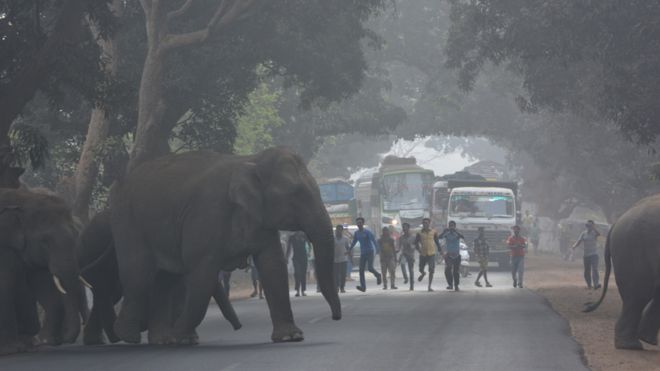
An elephant herd crossing a road before a crowd of people.

In India, the elephant is highly regarded by the public as a living embodiment of Ganesha, the god of prosperity, attainment, and wisdom. Therefore, any form of harm attributed to the elephant is strictly frowned upon. However, despite having a religious and cultural standing, the relationship between India's elephants and people has always been uneasy. This can be seen through incidences of elephants venturing into human settlements, resulting in human-elephant conflicts where the results are tragic for both people and elephants. Even during religious festivals, elephants have been known to turn violent at any given moment and attack anyone or anything in their way.  But lately, in the state of Orissa, there have been growing incidences of local people taking selfies with wild elephants leading to attacks with few killed as a consequence. One of these incidents occurred in December when Jaykrushna Nayak was returning home from a village market and sighted a large crowd in his village gathering around an elephant, taking photos and provoking it. He joined the crowd and tried to take a selfie with the elephant, when the infuriated animal wrapped its trunk around him and trampled him to death in front of everyone. Mr. Nayak was one of several people to have died for committing such a foolish and life-threatening act. In September, an elephant killed a security guard named Ashok Bharati who tried to take a selfie with it after getting too close to the animal. The incident, which was captured on video by some bystanders, showed Mr. Bharati inching closer and closer to the elephant, when the animal suddenly charged at him. Mr. Bharati tried to escape, but was beaten and crushed, eventually dying on the way to the hospital. The video of his death went viral.
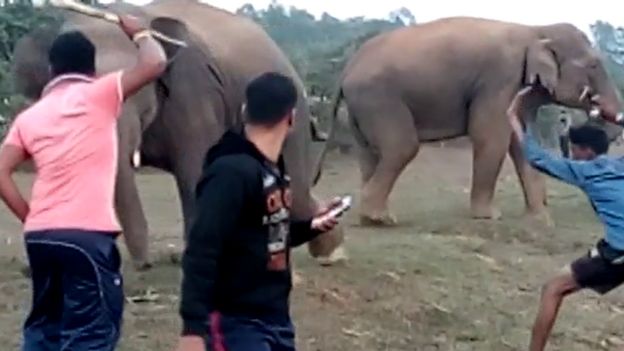
A group of young men attempting to what appears to be enticing the elephants for selfie.

Other selfie-takers managed to escape with their lives, but suffered severe injuries. One such example was seen in the case of Abhishek Nayak, an engineering student who was rushed to the hospital after being wounded by an elephant while trying to take a selfie with it. Six months later, he is still being treated for the serious injuries he suffered to his neck and stomach. According to Sandeep Tripathy, the chief wildlife warden of the state, the government of Orissa is taking this issue seriously by planning to set up "mock drills and special campaigns in sensitive districts to raise awareness" about the risk of getting too close to elephants. The government data has shown that 60 people have been killed by elephants in Orissa, but it is not clear how many have died due to a selfie. However, officials are concerned that the total number could increase because of the trend for selfies with the elephants. Wildlife expert Biswajit Mohanty indicated that the selfie craze has been intensified by the fact that a lack of food has compelled elephants out of the forests and into the towns and villages in search of food. This, in turn, leads to people getting excited on seeing the elephants in which they start taking photos of themselves with the animals, and ultimately end up being attacked. B.N Mishra, a forest range officer, pointed out that the flash from people's cameras provokes the elephants to attack. He further added that despite the efforts made to fight such incidences by organizing meetings with local residents, the people are simply being ignorant and not taking it seriously. Another forest officer named Ratnakar Das stated that he would frequently see people in the area attracting elephants with sugarcane, in order to take a selfie.
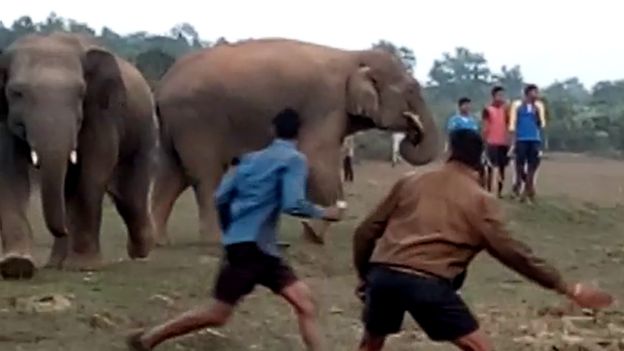
These brainless fellows are risking their lives trying to entice these animals for such a life-threatening stunt. 

I cannot think of anything more insane and life-threatening than a bunch of mindless people risking their lives trying to take selfies with elephants. These brainless individuals do not understand the meaning of respecting one's space when it comes to something as big and unpredictable as elephants. But what really aggravates me is that these people are not taking the advice and warning from wildlife personnel about the dangers of taking selfies with elephants seriously. This is another reason people in Orissa are constantly getting attacked, injured, and killed by elephants. How can you coexist peacefully with a wild animal like an elephant without following rules and guidelines provided by wildlife experts and various organizations who are doing what they can to help you stay safe from such animals? It is downright outrageous and senseless that such people choose not to listen to what experts say about what they are doing and ultimately never live to regret their mistakes. I urge the people of Orissa and other states in India where there are elephants to please not continue this dangerous game of taking selfies with the animals. If you care so much about your life and the well-being of elephants, then don't do it. Instead, I suggest the people of Orissa and other elephant-range states to collaborate with wildlife experts and conservation organizations in benefiting the elephants by protecting their habitats from poaching and deforestation, and further expanding their habitats to give the animals more space to roam. But most of all, they should seriously participate in workshops aimed at reducing human-elephant conflict in the country and follow the rules and guidelines from experts on how to peacefully coexist with the elephants.

View article and video here   

Monday, January 8, 2018

Can Declaring a River as a Dolphin Sanctuary Help Save Bangladesh's River Dolphins?

A dead Ganges river dolphin found in the Hathazari area.

The Halda River in Bangladesh is known for being a breeding ground for Indian carps in the country. The fish are a valuable source of food to residents living in and around the river. But not all residents are human; this 50-mile stretch of water is also home to the endangered Ganges river dolphin. Unfortunately, the dolphins are under severe threat from anthropogenic factors ranging from excessive pollution and utilization of dredgers for lifting river sand to the use of motorized boats. As a result, as many as fifteen dolphins have died in the last three months in the Halda River. Among those dolphins, one weighed around 70 kilograms and was found on January 5, while another weighed around 80 kilograms and was found on January 3. Both the dolphins were discovered floating in the same river and had sustained injuries on their bodies. The Halda River Research Laboratory indicated that the current number of dolphins in Bangladesh will not surpass 1,200. Out of the total number, approximately 250 dolphins are found in the Halda River. According to Professor Mohammed Manzoorul Kibria, a leading Halda River researcher from University of Chittagong, the rapid reduction in dolphin numbers in the river is a matter of serious concern. He called for urgent steps to conserve the river dolphins, which includes declaring Halda River as a dolphin sanctuary and halting random dredging without delay. Professor Saidur Rahman Chowdhary of Chittagong University's Institute of Marine Sciences and Fisheries added that pollution as a result of untreated solid and liquid waste from households and industrial units is threatening the Halda River's ecological balance. In addition, he called for a ban on using gill nets for fishing. A report by the Chittagong Department of Environment last year showed that untreated drainage released from various households and industrial units were polluting the river. It also indicated twelve recommendations to save the river from pollution, which included designating the dredging spots since random sand lifting increases the level of turbidity and enforcing a ban on motorized boats during the migration and spawning season of the fish.
A Ganges river dolphin leaping out of water

I really feel it is highly crucial to take necessary steps to save the dolphins of the Halda River. These animals are known for being bio-indicators, and their number in any aquatic area shows whether that area is polluted or not. The pollution in the Halda River not only affects the dolphins, but also the fish. Because the river is the largest breeding ground for Indian carps, both the dolphins and people rely on the river for survival. The ongoing dredging and disposal of untreated waste has affected and continues to affect the carp population. If this goes on, it will certainly affect the livelihood, health, and survival of the local people living in the vicinity of the river as well as further endangering the dolphins' lives. I think in order to stop the further impact of pollution, various households and industrial units should undergo significant improvement so that the waste does not end up in the river untreated. In addition, fishermen should be provided with a harmless alternative to gill net fishing and encouraged to use it in order to save the dolphins. But most of all, I believe it is essential to declare Halda River as a river dolphin sanctuary. One such example is seen in the state of Bihar, India, where a dolphin sanctuary was established on a 50-km stretch of the Ganges River. If India is able to establish a sanctuary for river dolphins, Bangladesh can too. Doing so would ensure the dolphins' survival through initiatives directed at curbing pollution caused by random dredging and uncontrolled waste disposal, and overfishing.

View article here               

Thursday, January 4, 2018

Should Other Countries Follow China's Example in Banning the Illegal Ivory Trade?

Elephants

The government of Tanzania and conservation organizations have recently applauded China's decision to ban the illegal ivory trade, indicating that the action gave hope for the future of Africa's elephants. According to Major General Gaudence Milanzi, Permanent Secretary in the Ministry of Natural Resources and Tourism, China's attempts, including the prohibition on all trade in ivory and its products, have helped reduce poaching levels in the country. He congratulated the Chinese government for the move which showed the global community that China was serious to end the ivory trade and protect the elephants, and urged other countries to do the same. Other government officials who praised China for its anti-ivory trade efforts included January Makamba, Minister of State in the Vice-President's Office responsible for the Environment, who credited China for its consistency in its leadership in climate change and other critical international issues. The State Forestry Administration of China has stated that the country has recognized its obligation to ceasing commercial processing and sales of ivory by the end of 2017. The administration also assured that China's authorities will continue to curb ivory collection, along with sales, preparing, smuggling, and transportation of elephant tusks. The affection has affected 34 processing companies and 143 authorized trading venues, with all of them to shut down, in the world's once largest ivory market.
January Makamba was one of several Tanzanian politicians who applauded China's ban on ivory trade.

I find this to be an incredibly good news that China has decided to put its foot down on the illegal trade of ivory. The country had long been viewed as the largest ivory market by conservation groups with several enterprises processing smuggled elephant ivory for public consumption. But now, it appears that China has changed its image by living up to its promise and banning the ivory trade. This means severe reduction in ivory prices which in turn results into a significant drop in Africa's elephant poaching. In addition, China also pledged that it will continue to combat and suppress the smuggling, transportation, processing, and sales of elephant ivory. This move has been applauded by various members of the Tanzanian government, including former President Benjamin Mkapa, who urged other countries around the world to follow China's example. I very much feel it is highly crucial that many other countries should emulate what China has done to save the elephants. A recent report by wildlife trade monitoring network TRAFFIC, with the support of the World Wide Fund for Nature (WWF), indicated that Japan is one of the largest markets of domestic ivory and has an active, though declining, ivory producing industry. It also mentioned that 2.42 tonnes of ivory, including tusks, antiques, and jewelry, were illegally smuggled from the country between 2011 and 2016. Tomomi Kitade, the report's co-author, stated that their findings showed that Japan's predominantly  uncontrolled domestic ivory is contributing to the illegal trade and it is necessary that the country's role in the global illegal ivory trade be recognized. Japan is not the only country involved in the illegal ivory trade; the U.S under the Trump administration recently announced that it will lift the ban on importing elephant ivory into the country from Africa causing widespread outrage amongst animal rights and environmental groups. The governments of the U.S and other countries should recognize the connection between the illegal ivory trade and terrorism. This is seen as African militant groups like the Lord's Resistance Army (LRA), Al-Shabaab, and Janjaweed benefit financially from elephant ivory as it provides them access to arms and ammunition to carry out their carnage against both local people and foreigners. This is not just a matter of global conservation of endangered species, but also of international security. I urge other countries across the world to follow suit, in order to put an end to the international illegal ivory trade.

View article here                   

Wednesday, December 20, 2017

Iran's Cheetahs in Desperate Need of Help as Extinction is On the Horizon

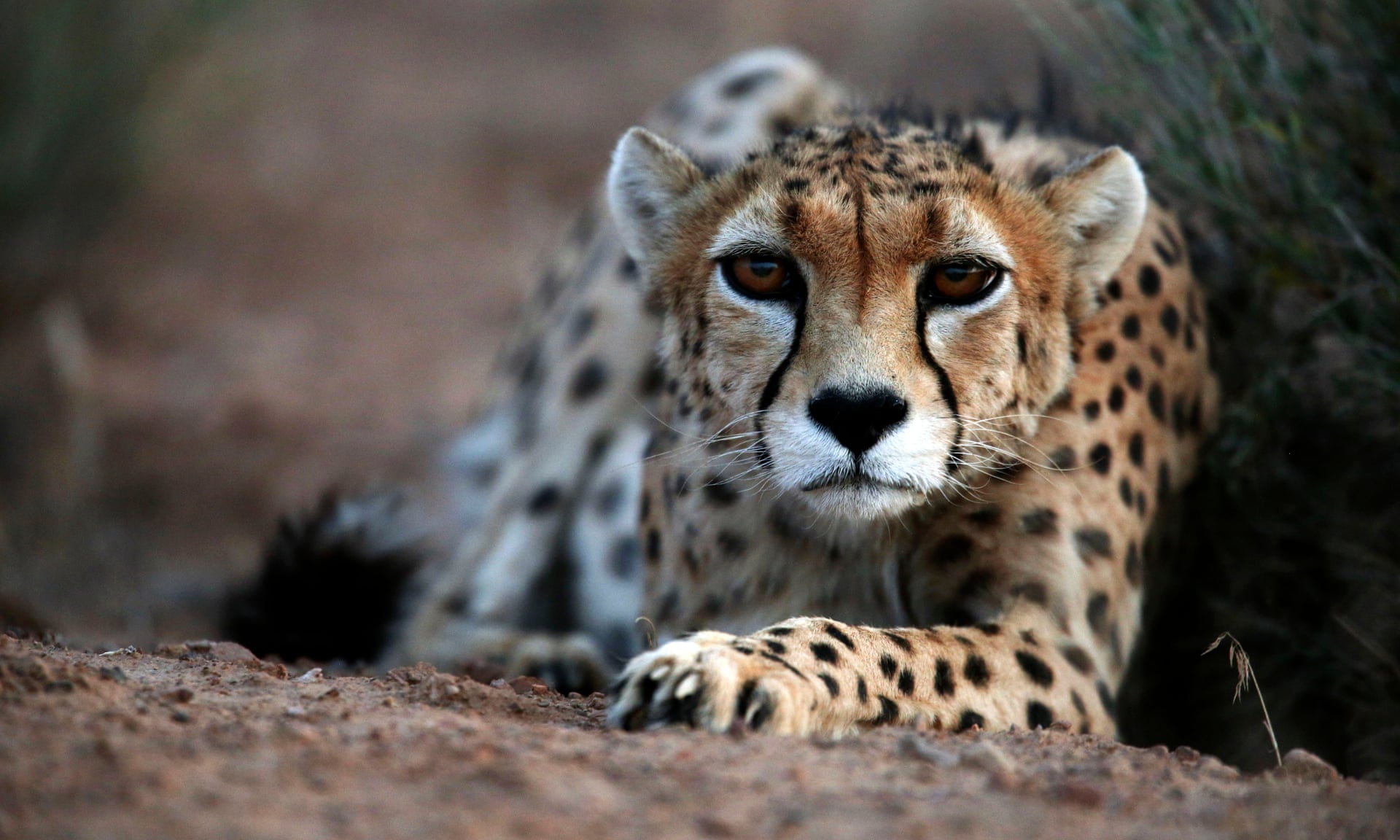
A seven-year-old male Asiatic cheetah.

The cheetah is one of several species of wild animals that epitomizes Africa in the people's mindset. This is true as seen in countless wildlife documentaries from past and present years. But what most people do not know is that there were and still are cheetahs in Asia. In centuries past, the Asiatic cheetah once ranged throughout the Arabian Peninsula and the Near East to Iran, covering Central Asia and the Caucasus, and extending all the way into India. Proof of these magnificent cats' existence is most notably seen in ancient Indian artwork from the Mughal era in which cheetahs are depicted hunting swift prey such as blackbucks and chinkaras for the emperors and maharajahs. They were also kept as companions for the royalty at the time. However, as time progressed into the 19th and 20th centuries, the attitude towards the cheetah in Asia changed dramatically from being seen as a hunter to the hunted. As a result, countless numbers of cheetahs were killed drastically throughout their former home range and ultimately confining them to the eastern half of Iran. Iran may be the last stronghold for the cheetah, but its numbers had been diminishing perilously since the 1970s due to man-made factors ranging from land-use change, habitat fragmentation and degradation, to persecution. As a result, fewer than 50 cheetahs are now left in Iran putting them on the brink of extinction. Scientists and conservationists are afraid that, without necessary intervention, there is little chance in saving these cats from extinction, especially after a decision made by the United Nations to remove funding from conservation efforts to protect them.

An ancient Indian painting depicting Mughal emperor Akbar hunting with cheetahs.
There had been several measurements in recent years to help increase awareness of the cheetah's plight in Iran. For example, in 2014, the country's national football team declared that their 2014 FIFA World Cup and 2015 AFC Asian Cup kits would be imprinted with pictures of the cheetah. Furthermore, a crowdfunding conservation project was established, and August 31 this year was declared "National Cheetah Day." Despite these efforts, the cheetah's decline has continued. According to Urs Breitenmoser of Bern's Cat Specialist Group, the cheetah has disappeared from Kavir in the western area, while individuals in the southern region are too sparsely spread for enough to interact and breed, and it is only around Touran and Miandasht in the north where there are enough individuals to control a population. Enforcing protection measurements of these last remnants of Iran's cheetah territory proved to be intensely difficult, due to cuts made by the country's government to its environment department's budget. Luckily, the United Nations Development Programme (UNDP) supported Iran's cheetah conservation project by being able to get money into the country when other international agencies could not. But now, the agency announced that it could not continue supporting the project financially after December because it had to make significant cuts in its budgets. Therefore, Iran should now handle the project alone.
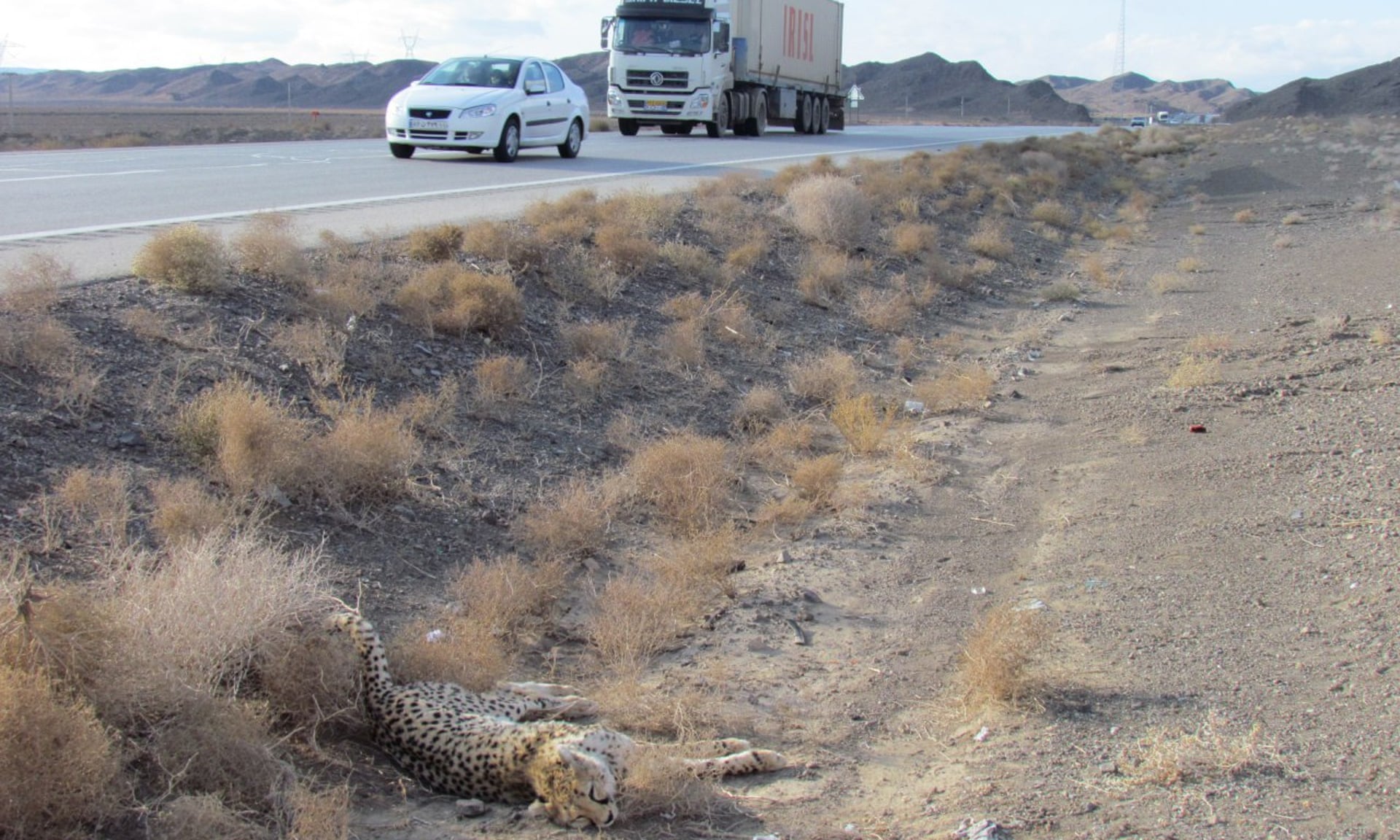
Despite the presence of signs warning drivers, many cheetahs like this one are killed by vehicles in Iran.

I do not know how to put it into words, but it is perfectly clear that the Asiatic cheetah is on a knife edge and will become extinct in a span of couple of years, unless drastic action is taken. This magnificent cat was virtually wiped out by anthropogenic factors in countries that were part of its historic range in Asia. Iran managed to save it from becoming extinct - until now. It is now the high time to take serious action to save the cheetah from extinction in Iran. The country had lost the Caspian tiger and Asiatic lion in the past; this cannot happen to the cheetah. With fewer than 50 animals left, it is in a desperate need of help and without substantial financial support from international agencies to Iran's cheetah conservation project, the cheetah will become extinct like the tiger and the lion. I urge the government of Iran to not give up on its cheetah conservation. I also urge the people of Iran to wake up and act upon this conservation issue that has remained unchanged since the 1970s. It is extremely crucial to reach out, educate, and encourage Iran's pastoral communities to refrain from hunting cheetahs and killing them in a retaliatory manner in order to protect their livestock. Instead, they should be provided with livestock guardian dogs like Anatolian Shepherds which were given to farmers in Namibia by the Cheetah Conservation Fund in an effort to prevent retaliatory killings of cheetahs. Furthermore, it is necessary to construct underpass tunnels that run underneath roads to prevent cheetahs from being killed by vehicles and also put an end to mining operations taking place in cheetah territories. The Asiatic cheetah's life hangs in balance and it is never too late to save it. But the world needs to act fast.

View article here           

Friday, December 15, 2017

Wolves in the U.S Should Deserve a Second Chance


Northwestern wolf
Two conservation groups have recently put up a reward of $20,000 to help condemn poachers responsible for killing two breeding female wolves in eastern Washington. One of the females' carcass was found on December 5 by the staff of the Washington Department of Fish and Wildlife (WDFW) fifteen miles southwest of the city of Republic in Ferry County. The female wolf's radio collar had stopped functioning in early November, which triggered the search for her body. She was a member of a wolfpack known as the Profanity Pack, who was fitted with a radio collar in 2016 to help the department personnel to track the pack as seven of its eleven members were shot to protect the ranchers' cattle. According to Police Captain Dan Rahn of the WDFW, the female was able to survive the shooting and most of 2017 while traveling on her own until she was killed by a poacher. The second breeding female was found dead by hunters on November 12 roughly ten miles southeast of Colville in Stevens County. She was found within the range of the Dirty Shirt pack and was assumed to be its member. The conservation groups that put up the $20,000 reward were Conservation Northwest and Cascadia Wildlands; each contributed $10,000 toward the reward.
With 45-60 animals left by 2016, the red wolf is on the brink of extinction in its native North Carolina homeland. A push for an end to the state's wolf recovery program by Republican senators has further put the species into jeopardy.

I find it very disturbing and saddening that these two female wolves lost their lives in the murderous hands of poachers. Both of these animals were breeding females, which conservationists had high hopes for regarding the restoration of wolves in the northwestern U.S. But now, those hopes have been shattered hindering the researchers' works and putting the region's wolf population in jeopardy. It goes to show that wolves in the U.S are not getting a second chance to recolonize areas where they had long disappeared, due to human persecution. What is more shocking is that wolves in Washington coexist alongside domestic livestock without incident, yet people resort to lethal methods to eliminate them just to protect their animals. Furthermore, the federal government is also involved in this issue about the relationship between wolves and making decisions that are disheartening to conservation groups committed to protect the animals and ensuring their survival and well-being. In November this year, Republican senators pushed for an end to North Carolina's red wolf recovery program putting the animal's life in jeopardy. It is extremely appalling that the federal government makes such a decision that would spell doom to a species that is on the brink of extinction because of human persecution and pressure. In addition, the relationship between people, especially ranchers, and conservation groups concerning wolves is very strained. Nick Cady of Cascadia Wildlands stated that whenever the group takes legal action, it gets threats. The public needs to understand that these groups are not only trying to save wolves, but also helping farmers and ranchers to peacefully coexist with them. However, there are also people who simply do not care about wolves and would rather see them go extinct. These people could be in Washington, North Carolina, Arizona, or anywhere in the country where wolves are present and they show their colors by sending threats to conservation groups in an attempt to stop them from doing what is right for both wolves and the public. These are the kind of people that should be substantially dealt with. Both gray wolves and red wolves are part of the United States' natural heritage and should deserve a second chance.

View article here                                             

Wednesday, December 6, 2017

Asiatic Lion Reintroduction Project- Madhya Pradesh Backs Down


An Asiatic lion pair in Gir Forest National Park
The state of Madhya Pradesh has recently appeared to have given up on the Asiatic Lion Reintroduction Project from Gujarat's Gir Forest National Park to Kuno-Palpur Wildlife Sanctuary. The state government, after almost twenty years of unsuccessful struggle with Gujarat over transfer of Gir Forest's lions, has unofficially abandoned hope on the project. An order by the Supreme Court authorizing the translocation of lions to Madhya Pradesh could not influence the government of Gujarat from providing the big cats. The government of Madhya Pradesh has instead decided to release and rehabilitate tigers in Kuno-Palpur sanctuary which they claim is ready. The decision came from Chief Minister Shivraj Singh Chouhan during a State Wildlife Board meeting, suggesting at a probable failure in getting lions from Gujarat. Sources indicated that the decision to bring tigers in Kuno-Palpur sanctuary clearly shows that the government of Madhya Pradesh has lost hope on bringing lions from Gujarat. Although the government had announced and evacuated a 345-sq. km area for the sanctuary in 1981 and created an extra 900 sq. km of buffer zone in 2015, it did not acknowledge declaring the buffer zone area as a sanctuary which is being argued by the government of Gujarat. Sources further added that wildlife experts and officials from the Ministry of Environment and Forests (MoEF) in a turnaround position also predicted that without notifying the areas as a sanctuary, it would be harmful to the lions' breeding and survival.
View of Kuno-Palpur Wildlife Sanctuary

It looks this ongoing debate between the governments of Gujarat and Madhya Pradesh about the reintroduction of the Asiatic lion has come to a halt. For nearly twenty years, the two governments had been constantly arguing of translocating lions from Gir Forest to the forests of Kuno-Palpur Wildlife Sanctuary in Madhya Pradesh. Much of the arguments given by each side were largely political with the Madhya Pradesh government arguing that Gujarat's lion population has increased to such an extent that the animals should be transferred to Madhya Pradesh so that the state could start its own lion population. The government of Gujarat, on the other hand, was reluctant to do such a thing arguing that the lions are the "state's heritage" and that the poachers targeting them in Gir Forest come from Madhya Pradesh. Eventually, the Madhya Pradesh government gave up hope and has now decided to release tigers into Kuno-Palpur Wildlife Sanctuary.
The government of Madhya Pradesh is now focusing on releasing tigers into Kuno-Palpur Wildlife Sanctuary

I find this news very interesting because it marks the end of the 20-year debate between Gujarat and Madhya Pradesh over the translocation of lions outside Gujarat. However, it also implies that the efforts Gujarat government put in challenging the Supreme Court's order in 2013 about lion translocation in Madhya Pradesh have paid off. Two years ago, the government of Gujarat presented an argument to the Supreme Court based on studies and guidelines of the International Union of Conservation of Nature (IUCN), a petition filed by the Wildlife Conservation Trust, Rajkot, and a report by the National Tiger Conservation Authority (NTCA). The argument stressed that reintroducing lions in Kuno-Palpur Wildlife Sanctuary may prove to be harmful for lions, the wildlife sanctuary is an important corridor for tiger movement between Ranthambore National Park and Sehore district, and that the lions are not in any threat of extinction for the next hundred years. Before presenting such an argument, Gujarat government was mainly stressing about the lion being the state's heritage. This showed that the collaboration between conservation groups and governments can make a difference in issues related to wildlife and conservation. The government of Madhya Pradesh now wants to release tigers into Kuno-Palpur Wildlife Sanctuary, but it has not notified that the sanctuary's buffer zone is a protected area which the Gujarat government has argued. It is highly essential that the Madhya Pradesh government announce the sanctuary's buffer zone as a protected area before releasing tigers into Kuno-Palpur. At the same time, the government should collaborate with conservation groups to ensure the animals' safety and well-being.

View article here                      

Tuesday, December 5, 2017

Can Instagram Warn People About Wildlife Exploitation?

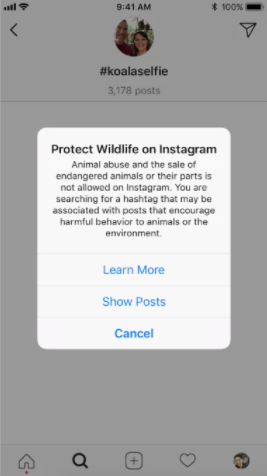
Instagram's message to all its users about abuse towards endangered wild animals

Social media platform, Instagram, has recently joined the battle against cruelty related to wildlife. This can be seen that when an Instagram user either looks for or clicks on a hashtag that is usually linked to abusive behavior towards endangered species such as posing with or holding wild animals, the following warning message would show up: "You are searching for a hashtag that may be associated with posts that encourage harmful behavior to animals or the environment." When the user clicks through to "Learn more," he or she is guided to a page on wildlife exploitation with information warning tourists against taking photos with endangered exotic animals. Instagram has worked with several wildlife organizations such as the World Wide Fund for Nature (WWF), TRAFFIC, and World Animal Protection, to find the most commonly used hashtags identified with abusive behavior towards animals, including animal tourism and the illegal wildlife trade. An Instagram representative indicated that hundreds of hashtag combinations will now produce the warning. These combinations range from phrases that turn to be used on photos of tourists with captive animals such as #lionselfie, to more outrageous ones linked to illegal wildlife trafficking like #exoticanimalforsale. A simple cursory search of such hashtags can result in thousands of photos showing people touching the animals or posing next to them being held in captivity.

Instagram logo
Although most people know that trafficking endangered species and selling their body parts is illegal and harmful to them, everyone does not consider photos of someone either holding a monkey or riding an elephant as threatening an animal's well-being - but they often can be. Some signs of whether an animal may be being mistreated include an animal being held, constrained or kept caged for tourists. Initially, Instagram had a policy that did not permit images showing animal abuse or sale of endangered animals. But now, the staff in support of the app's monitoring and reporting system have received further education from wildlife experts on what kinds of activities are abusive or illegal when it comes to animals. Instagram's latest program warning users about wildlife exploitation works much like those installed by the platform last year related to issues of self-harm, which triggered a pop-up message to users looking for hashtags related to eating disorders, suicide, and other topics. However, Instagram's warning system does have its drawbacks. For example, the message which pops up after clicking on a given hashtag related to wildlife photos would not show up to warn a user if he/she is the one posting a photo with the hashtag. In addition, anyone who sees the warning can easily click "show posts" and go about their search for such photos. According one Instagram representative, the goal of this program aims to educate people who might not know that their actions can support activities in the tourism industry that are harmful to animals.
Due to the popularity of elephants in Asia's tourism industry, tourists have their pictures taken riding on them often not understanding the animals' well-being.

I find it very impressive and beneficial that Instagram has joined forces with wildlife organizations to warn and educate users about the cruelty behind photos they take of themselves with endangered wild animals. By setting up such a program that warns users about hashtags associated with posts encouraging wild animal abuse and information related to wildlife exploitation, Instagram is reaching out to the global community and raising awareness about the illegal wildlife trade. However, the program's limits include not showing the warning message to users who themselves post photos with hashtags related to wildlife exploitation and that anyone who sees the warning can simply ignore it and proceed to look at such photos by clicking "show posts." I think out of these two drawbacks, the biggest problem is that people choose to ignore the message and spend their time enjoying looking at photos of other people holding endangered wild animals, touching them, taking selfies with them, or doing anything that encourages harmful behavior to the animals. How will people learn about the harmful effects of wildlife exploitation on endangered species, especially if they have never made physical contact with such animals and took pictures of themselves with animals? This is why I believe people should take Instagram's warning very seriously and learn to respect endangered species by giving them their space, never purchasing products made out of their body parts, and understanding the harmful effects of poaching combined with the illegal smuggling of wildlife. At first, these photos of tourists posing with endangered species may appear fun and humorous to look at but when you scratch the surface, it is not what it appears to be. Many of these animals are captured from their natural habitat, kept in cramped conditions, and constantly passed around from one tourist to another for picture-taking which causes extreme trauma. Therefore, people should reconsider their decisions of having their pictures taken with endangered animals when traveling to exotic places and never be fooled by the photos taken of themselves with such animals. If you care so much about the animals and their well-being, then don't do it. Simple as that.

View article here