Monday, July 5, 2010

Leopard Beaten to Death after Injuring Nine

Indian leopard

In Gujarat's Banaskantha district, a leopard had strayed into a village locality and injured nine people including a forest guard. The animal was about to be tracked down to be tranquilized and then released faraway from the village. Unfortunately, the villagers had been beaten it to death by the villagers. This is truly a shocking and devastating news for me. One reason is because the animal was an endangered species. The second reason, which is more reasonable, is that a posse of forest officers, police, and forest department officials were about to relocate the victim somewhere safe. But it seemed that the villagers could no longer tolerate such encounters, and were forced to retaliate. I just hope that in the future, the forest department will educate the villagers on what to do when there is a man-animal conflict in their village. It would be wise to immediately notify the forest department when such incidents happen.

View article here

Sunday, July 4, 2010

Two More Injured in a Tiger Attack in Maharashtra

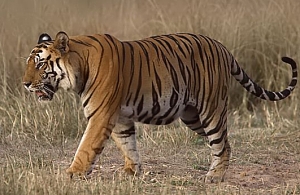
Bengal tiger

Recently, the same frail tigress who had injured one person in Maharashtra's Tadoba Andheri National Park has attacked two more people after forest officials tranquilized and released her away from the villagers. The animal was then again tracked down, tranquilized, and was taken for a check-up. Later, it will be decided whether the animal will be shifted to a zoo in Nagpur.

I sure am relieved to see that the tigress is safe. I'm also happy that forest officials along with the police had come up with an alternative solution to keep both the animal and villagers safe out of harm's way. However, I'm also little bit worried whether this animal may have a reputation of being a man-eater or not. But for now, all is well. I also hope that in the future, forest officials in Tadoba Andheri National Park will keep monitoring its tigers to check for any signs of disability and help those in need. That way, both the villagers and animals will be able to live peacefully.

View article here

Bangladesh Raises Question of Tougher Laws to Save its Tigers

Bengal tiger

Bangladesh has come up with a topic of enforcing laws similar to the one's its neighbor India has, in order to save its tigers. Wildlife experts and enthusiasts persuaded the nation's government to revise the Wildlife Protection Act, in which poachers only end up serving two years in jail. Both India and Bangladesh share a complex and mysterious delta known as the Sunderbans, which is home to the largest number of Bengal tigers than anywhere else in the Indian Subcontinent. Although many of the tigers have earned an infamous reputation as man-eaters, they are still threatened like others. One of the issues that may lead to Sunderbans' tigers turning to humans is the depletion of prey species, which in this case, is spotted deer.

I sure hope that like India, Bangladesh will come up with a much stronger law with stiffer penalties in order to help save its tigers. Because even though they are man-eaters, they still count as threatened species in our world. And while it's clear that there are several factors which lead to them turning towards humans as prey, one of them happens to be loss of their natural prey species. This type of factor was also seen in the case of the Indian wolf.

View article here

Saturday, July 3, 2010

Tiger Attack Leads to a Mob Frenzy

Bengal tiger

In Maharashtra's Tadoba Andheri Tiger Reserve, an ailing tigress attacked and seriously injured a villager which led to a mob of angry villagers beat up two forest officers. This was an extremely dangerous situation, as the animal was old and frail which also indicates that it could be a man-eater. Even more horrifying was that the victim attempted to drive the animal away when he saw it. Looks can be deceiving, huh?

This was not the only incident where villagers living in rural India suddenly turn towards forest officials in anger. Few weeks ago, villagers held protests towards forest officials in Orissa's Bhitarkanika National Park after a saltwater crocodile took a woman's life. The reason for that was because all the villagers living in the area had suffered heartbreaking losses of their own people to the gigantic reptiles in these past few months. This issue, along with the one involving a tigress gives an idea how a community feels when a wild creature either seriously injures or even kills its own member. In the case of Tadoba's and Bhitarkanika's villagers, it seemed like revenge. I can only hope and pray that some alternative solutions would be put into action, and it can be more than just monitoring the perpetrators responsible for such gruesome deeds. Hopefully, the forest department in both the places may find some way(s) to keep the villagers safe from the predators.

View article here

Tiger Attack in Ranthambore National Park

Tiger in Ranthambore National Park, India

A man was fatally mauled to death by a tiger in Rajasthan's famed Ranthambore National Park while he had gone out to collect firewood. This was the second time a tiger attack had occurred in the national park in three months. When I heard about the first tiger attack in the national park, I felt very shocked as with any man-animal conflict. But this second incident made me worry. Will Ranthambore's tigers be next in line to turn into man-eaters? For generations, the Sunderbans National Park of West Bengal and Bangladesh have been notorious for its tiger attacks as people rely on the forests for food and living. I sure hope that the forest department of Rajasthan with help from conservationist groups may come up with a solution to keep both people and tigers safe from harm's way.

View article here

Friday, July 2, 2010

Hawaii Bans Shark Fin Harvesting

Shark fins confiscated

Just recently a law banning the harvesting of shark fins took into effect in Hawaii. This bill not only made the harvesting process illegal, but also selling, possessing, and distributing of shark fins as well. It is truly a wonderful moment for me to see that one of the islands in the South Pacific has taken a proactive step against a devastating environmental issue that's affecting our world's oceans. But elsewhere, shark fin harvesting is still a major threat to the ocean life.

Hawaii has long been viewed as paradise on earth with its sunshine, beaches, and surf. Now there is another characteristic that makes it a special place: it's conservation efforts. First, it was to help save and protect its own native wildlife such as the Hawaiian goose and the monk seal. Now, Hawaii has taken a step further in conservation of a more diverse ocean species: the sharks. This is definitely something to feel proud of.

View article here

'South Africa's Rhinos Safe--For Now,' says SANParks Head

White rhinos in Kruger National Park, South Africa

South Africa has been suffering with a soaring increase in rhino poaching, losing a total of 124 animals this year. According to Dr. David Mabunda, chief executive of SANParks (South African National Parks), the nation's rhino deaths represented only small percentages of the total rhino population. However, he also firmly persuaded the public to keep a sharp look-out for any suspicious activities in South Africa's wild lands. I think in addition to urging the public, Dr. Mabunda could have also asked for collaboration with other African nations in order to crack down on these illegal poaching activities decimating South Africa's rhinos. That way, South Africa's rhinos would be safe from the greedy hands of poachers.

View article here