Thursday, September 12, 2013

United States to Demolish Stocks of Ivory in Effort to Halt Global Elephant Poaching

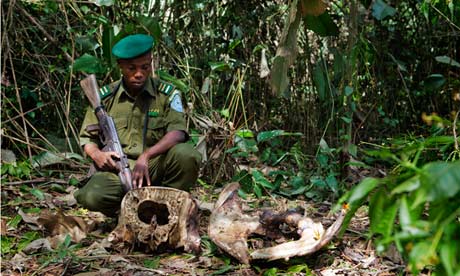
Congolese park ranger with a skull of an elephant killed for its ivory

The Obama Administration has recently announced that it would destroy six million tons of confiscated ivory stocks, in order to boost up efforts to curb an illegal ivory trade that has brought wild elephants to the brink of extinction. The destruction, which was announced by U.S Secretary of State Hillary Clinton and her daughter Chelsea, was part of a large effort by the administration to levitate illegal wildlife trafficking from a paltry conservation interest to serious national security concern. Officials stated that the destroying of ivory would indicate that President Barack Obama was dedicated to halting the illegal trafficking of wildlife that has ravaged species such as elephants and rhinos. They further added that the destruction is scheduled to take place on October 8th. U.S Interior Secretary Sally Jewell announced that a new advisory council, which consists of former administration officials, and business and conservation leaders, will help direct the clampdown on criminal poaching syndicates. She also added that wildlife trafficking had increased over the past five years into an international trade worth $10 billion. The poaching of elephants had doubled by a factor of eight in Tanzania, while the slaughter of rhinos had been elevated by a factor of fifty. In response to the United States' decision to destroy ivory stocks, conservation groups felt that the move would hurt the contraband market. A similar action was conducted by governments in a number of other countries, including the Philippines where fifteen million tons of confiscated ivory were crushed by industrial rollers earlier this year. The recently seized ivory in the U.S included raw tusks and carved ivory apprehended by authorities in the last 25 years.

This article is a clear representation that the U.S is committed to the battle against the threat of illegal wildlife trafficking. This can be seen through the response of U.S State Department officials towards the issue, referring it as a national security crisis. One of the notable political figures who plays a prominent role towards the issue is Secretary of State Hillary Clinton, who stated that as many as 35,000 African elephants were killed last year, accounting to 96 elephants killed in a single day. At this pace, Africa's elephants will become extinct within ten years. She further added that the profits from the illegal trade of ivory were also inciting extremist groups, including associates of Al-Qaeda in Somalia. In the end, she stated that the only way to stop wildlife trafficking is by using a zero-tolerance strategy. In my opinion, this is an absolutely crucial component in the battle against the illegal wildlife trade. By implementing a zero-tolerance policy against the poaching and trade of the world's wildlife, the criminal syndicates monopolizing in these illicit activities would not stand a chance. One of the methods mentioned in this article is imposing tougher penalties on the perpetrators, which the Obama Administration is thinking of introducing. I also feel that a joint partnership among several countries worldwide in targeting and prosecuting these syndicates is also vital in the ongoing battle. This way, the illegal trafficking of wildlife will most likely cease to function.

View article here

Tuesday, August 20, 2013

Climate Change Threatens the Iberian Lynx

Iberian lynx

It has been recently announced that the Iberian lynx is under threat from climate change. A new international study has found that the critically endangered cat could be driven to extinction within fifty years, despite important continuous conservation efforts. Researchers stated that the impact of climate change must be included in strategies to reintroduce the lynx to new habitats, in order to save the species. Present-day management efforts could be pointless if the linked effects of climate change, land use, and prey abundance on population changes of the Iberian lynx are not taken into consideration. Despite the evidence of increase in lynx numbers in the past decades due to intensive management, researchers warn that current conservation strategies could buy just a few ten years before the cat becomes extinct. They stated that the study is the most absolute conservation-management model yet cultivated of the effects of climate change on predator and its prey. They further added that the present increase in numbers of the lynx indicates that accelerated management of habitat and rabbit populations have worked as effective temporary conservation strategies. However, a small population size means that the species is still under threat and prone to future declines in population. This also means that the species is very vulnerable to changes in habitat quality or changes in prey abundance due to climate change.

I very much hope that various conservation groups involved in an effort to save the Iberian lynx will take into consideration about the threat of climate change, and incorporate that into their methods in order to save the species from extinction. The current methods that are being used are only temporary solutions to ensure the survival of this critically endangered cat. Most of these strategies included habitat management, reduction in human activity, and recently reintroduction of the lynx in appropriate areas where it has lived. But now, with climate change in focus, the conservation efforts in saving the Iberian lynx are going to change in some degree. For example, studies by researchers have shown that habitat in the southwestern part of the Iberian Peninsula, which houses two existing populations of Iberian lynx, is most likely to be unfavorable by the middle of this century. In order to ensure the survival of the species on the long run, it has been suggested that peninsular regions at higher altitudes and latitudes would be suitable for the lynx.

View article here  

Monday, August 19, 2013

Kenya Unveils its Inter-Agency Anti-poaching Unit

Confiscated ivory

It has been recently reported that Kenya has revealed its inter-agency anti-poaching unit, which consists of officers from specialized aspects of the Administration Police, General Service Unit, and Kenya Wildlife Service (KWS) in an effort to bolster the fight against poaching. According to Paul Muya, spokesperson for the KWS, the establishing of this organization shows the government's obligation in guaranteeing that the wildlife is safe. He stated that the KWS was working with other conservation stakeholders to confirm that the war against poaching is won. He further added that the increasing poaching crisis has become both an economic and national security issue. In addition, he also pointed out that the KWS requires more resources for it manages roughly eight percent of the country's total landmass which includes 22 national parks, 29 national reserves, and four national sanctuaries including six national marine reserves and four parks. Furthermore, Muya noted that the number of active rangers has decreased significantly due to natural abrasion and retirement. He stated that the government has however made an obligation during this financial year to advocate the enlistment and disposal of at least 1,000 new rangers, in phases, to bolster KWS's capacity to conduct their authority effectively. Muya also indicated that the KWS will continue working with other law enforcement agencies, particularly the Customs, Immigration Department, Interpol, Kenya Airports Authority, Lusaka Agreement Task Force (LATF), and the police in making sure that international and local laws on wildlife crimes are carried out.

This article gives a clear demonstration of a nation's tough stand against poaching. This is seen through joint collaboration between a wildlife agency and other law enforcement agencies such as the police department, customs, and immigration department, among others, in an effort to put a stop to the ever-increasing threat of poaching. Kenya had earlier lost 384 elephants and 29 rhinos to poaching last year. This year, the country has lost 190 elephants and 34 rhinos. Furthermore, the government is enthusiastic on the quick execution of the Wildlife Conservation and Management Bill, 2013, which suggests inflexible and preventative punishments against poaching. In addition, there is even a genetics and wildlife forensics laboratory being built at the KWS headquarters and is set to be installed later this year later this year to support prosecution of wildlife crimes. Although this is promising news regarding wildlife protection, I also feel that Kenya could further bolster its stand against poaching by forming alliances and helping other African nations that do not appear to be taking a similar stand against the threat. For example, Tanzania has recently been in the news where senior officials within the nation's government are behind elephant poaching. Many of these officials come from key government departments responsible for wildlife conservation. The news indicates the threat of corruption is looming large in the nation, and is ultimately responsible for depriving Tanzania's wildlife of its safety. Therefore, I believe that those African countries whose individual governments have made a commitment to take decisive action against poaching and other wildlife-related crimes should provide help to the ones that are not standing a chance in the battle.

View article here

Monday, August 12, 2013

Federal Plan to Increase Range for Mexican Wolves in Arizona

A Mexican wolf inside a holding pen in New Mexico's Sevilleta Wildlife Refuge.

It has been recently reported that the U.S government is providing a plan that would allow Mexican wolves to roam freely across the state of Arizona for the first time. The U.S Fish and Wildlife Service published a draft of the proposed changes last month that, if enforced, would let wolves roam from western Arizona to eastern New Mexico between Interstates 40 and 10. The draft contains likely wolf reintroduction sites in northern Arizona on the Tonto National Forest, all over the Sitgreaves National Forest and other public lands, as well as private lands where there is a cooperating landowner. In addition, the proposal also demands expansion of an area where the wolves could wander to add parts of central New Mexico's Cibola National Forest. As a whole, there would be a decennial increase in the area where biologists are working to restore the population. Environmentalists accepted the possibility of expansion, but also expressed concerns about provisions that could create schemes that would increase situations in which the wolves could be killed for livestock predation or other reasons.

I'm very proud and grateful that the federal government has given the consideration about the conservation of Mexican wolves, and acted upon it by proposing a plan that would allow them to flourish in parts of the American Southwest where they had disappeared. This proposal has received a great deal of support from groups, especially the Apache tribe, who has an agreement with the U.S Fish and Wildlife Service that has let the wolves to roam on their lands in eastern Arizona. In addition, wolves have been sighted in the past in northern Arizona as close to places like Mormon Lake and the city of Flagstaff and Holbrook along Interstate 40. This has led scientists to choose the Grand Canyon as principal wolf territory. They stated that the region could support as many as 200 animals. However, this proposal has also received negative opinions from ranchers in Arizona who feel that the program to reintroduce wolves back into their former haunts has been unsuccessful and that they cannot afford any loss of livestock from these animals. I firmly believe that the U.S Fish and Wildlife Service and other groups actively involved in this project should identify particular areas in Arizona and New Mexico that do not include any ranches. If these areas happen to be close to any ranch lands, then the groups should take the initiative in educating ranchers about the ecological importance of Mexican wolves and provide them with safe measurements to keep wolves off their ranch. One possibility would be to erect fencing high enough to keep the wolves out, and another would be to provide ranchers with livestock guardian dogs to prevent the wolves from attacking their livestock.


View article here 

Friday, August 9, 2013

Tiger Range Countries to Correct Cross-Border Conservation

Tiger

It has been recently reported that representatives from twelve out of the thirteen tiger range countries attended a meeting held in the city of Kunming last week, where they came to an agreement on taking measurements to correct managing of cross-border landscapes and on battling the illegal wildlife trade of tigers. This general agreement, known as the "Kunming Consensus", is targeted at improving earlier obligations made by tiger range countries and supported by heads of state through the St. Petersburg Declaration and the Thimphu Agenda. All are focused at accomplishing the countries' overall goal to increase the number of wild tigers to 6,000 animals by 2022. The blueprint to achieving this goal is the conservation of tiger habitats shared across national borders of such countries. It is said that there is more than three times as much promising tiger habitat in trans-boundary landscapes (920,000 square kilometers) than in any single country's landscape (270,000 square kilometers). Therefore, the consensus advised that the countries examine how best to guarantee management of their trans-boundary landscapes is effectual in the long-term. The consensus also made other recommendations for issues such as the illegal trade of tigers, which includes using innovational enforcement techniques, correcting enforcement capacity through training, and urgently, reconstructing sharing of information and international organization between enforcement and other bureaus. In addition, the consensus also made recommendations regarding efforts to minimize the demand for tiger body parts through figuring out the market for such items and building measures to discourage their consumption.

I'm very proud and grateful to see that majority of Asian countries that house the world's wild tiger populations have come to an agreement in helping one another in an effort to protect their tigers. This consensus outlines various steps these countries are expected to adhere by to ensure that the global tiger population would increase to 6,000 animals by 2022. Leading the way towards this goal is Nepal, which is reported to have its tiger numbers increased to 198 making it a 63 percent rise from the last survey in 2009. In addition, there was also some progress seen on the island of Sumatra in Indonesia. However, it is unclear what might be the situation in the remaining eleven tiger range countries. This is why I hope that these countries will take the initiative in further improving the measurements in managing cross-border landscapes and combating the illegal wildlife trade in an effort to save tigers and other wildlife.

View article here 

Tuesday, July 30, 2013

Census Shows Increase in India's Tiger Population

A pair of tigers

A latest census has indicated that India's tiger population is on the rise in the state of Maharashtra, and numbers in other states are either rising or remaining constant. However, wildlife experts are still upset over the conservation efforts which are hindered by uncontrolled poaching and development of infrastructure projects in forest areas. Experts state that while the source population has been well-protected in most states since 2006, the offspring that scatter beyond the core sanctuary fall victim to poaching and human development. The latest data showed that the average number of tigers in Maharashtra rose from 103 in 2006 to 168 in 2011. In addition, new surveys that were carried out with the use of camera traps revealed that other states like Assam, Karnataka, Kerala, and Tamil Nadu also saw a growth in the tiger population. According to Kishor Rithe, a member of the National Board of Wildlife, the reason for the rise in tiger population is due to some steps taken by various states. For example, Maharashtra proposed five new tiger sanctuaries in the past three years and brought 620-square kilometer area under legal cover. These new sanctuaries are in controlled locations for breeding and safe diffusion of tigers. Furthermore, the government has also moved over 17 villages from the core areas of these sanctuaries. Other states, however, have not declared so many sanctuaries for tigers. He further pointed out that these figures are only an illusion, as bigger dangers still threaten the tigers' survival. Experts state that poaching is more ignored and undetected, compared to other crimes. Independent estimates indicate that only two to three percent of poaching cases are disclosed, of which only a minute reach the conviction stage. Nitin Desai of the Wildlife Protection Society of India stated that there is a total lack of intelligence network to prevent poaching, and that poachers are more aware of tigers' movements and the precise time they would appear at a specific waterhole, compared to forest officials.

I feel this article provides the reality behind the good news of India's tiger population. Although the numbers show that the population on the rise, there is lack of evidence for that surge. For example, Maharashtra and few other states have shown an increase in tiger numbers due to various steps they have taken in ensuring their survival. These include declaring more sanctuaries at controlled locations for breeding, relocation of villages from core areas, and through the use of camera traps. It is unclear what methods forest officials in other states are using to ensure that tiger populations are either increasing or staying stable, but I'm assuming that tigers in those states are dispersing beyond the core areas making them vulnerable to infrastructure development projects and poaching. I firmly believe that the remaining states in India where tigers thrive should implement the tactics used by Assam, Karnataka, Kerala, and Tamil Nadu, in order to guarantee the survival of tigers. Furthermore, the threat of poaching is an extremely serious matter and every state across India should form an intelligence network comprising of not just forest officials but also local police departments and other authorities to prevent the perpetrators from conducting their illegal activities. Furthermore, tough penalties should be imposed on poaching regardless of what animals are the victims and how many are killed.

View article here            

Wednesday, July 24, 2013

Blackbuck Poaching Sparks Protests Among the Bishnoi Community


The poaching of blackbucks has been in the news in recent times, but one story that has stood out took place in Rajasthan's Sri Ganganagar district where the continuous poaching of these magnificent antelopes has sparked protests among the Bishnoi community. Members of the community asserted that there had been as many as sixty reported cases of blackbuck poaching in the past six months. A recent incident occurred near 6 TK village near the town of Muklawa, where villagers witnessed a blackbuck caught in a trap set up by poachers. They immediately contacted the forest officials, but they did not arrive for three hours. The forest department has filed an FIR against the unidentified perpetrators under several sections of the Wildlife Protection Act. According to animal activist Nanu Ram Bishnoi, the Muklawa area is home to about 2,500 blackbucks but are now severely threatened by the ever-growing incidents of poaching. He further added that although FIRs were filed against the unknown poachers, the investigation was not properly carried out. The Bishnois stressed that forest officials do not reach the scene of the crime on time when they are informed of a poaching incident. However, officials stated that much of the poaching incidents were documented in Sri Ganganagar's revenue land area instead of forest area.

A Bishnoi woman; the Bishnoi people are well-known for their unconditional love of  wild animals and will not hesitate to take action against those who would inflict harm upon them. 

I'm very appalled and disappointed by the way forest officials have been responding to various incidents involving poaching of blackbucks. This article clearly demonstrates how the Bishnoi have a complete mistrust of individuals committed to the protection of wildlife that share the lands with their human neighbors. Because of this negligence, poachers are able to evade arrests and prosecutions and continue to conduct their illegal activities. I feel that if the forest officials are going to continue to delay their responses to such poaching incidents, then only the Bishnoi people can take matters into their own hands to protect the blackbucks and other wild animals. These people had long been renowned for their unconditional love of nature, and have sacrificed their lives in  protecting the plants and animals that live side-by-side them. The most notable example of these people's efforts in protecting nature was the Khejarli Massacre, in which 363 Bishnoi men, women, and children sacrificed their lives saving the khejri trees from being cut down by Maharajah Abhay Singh of Jodhpur to build his palace. Even in present-day India, the Bishnoi continue to protect the plants and animals that live alongside them and never refrain from taking action against those who would bring harm to them. The two most famous cases involved Bollywood megastar Salman Khan and former Indian cricketer Mansoor Ali Khan Pataudi, each of whom were held responsible for illegal poaching of blackbucks leading to the Bishnois staging strong protests against these two men. Recently, the Bishnoi community has launched protests against the killings of blackbucks perpetrated by poachers and alleged that forest officials were delaying their responses during the times of each incident. Activist Nanu Ram Bishnoi stated that the community has presented a memorandum to local district administration officers addressing Rajasthan chief minister Ashok Gehlot that these incidents must be stopped. Suppose there is no response from the state government of Rajasthan to take decisive action against this ongoing catastrophe, then the only option for the Bishnoi people would be to deal with the problem on their own terms. Even if it means sacrificing their lives the way their ancestors did hundreds of years ago.

View article here