Monday, May 18, 2026

Bangladesh’s Sundarbans Crackdown: Inside the Fight for a Forest Under Siege

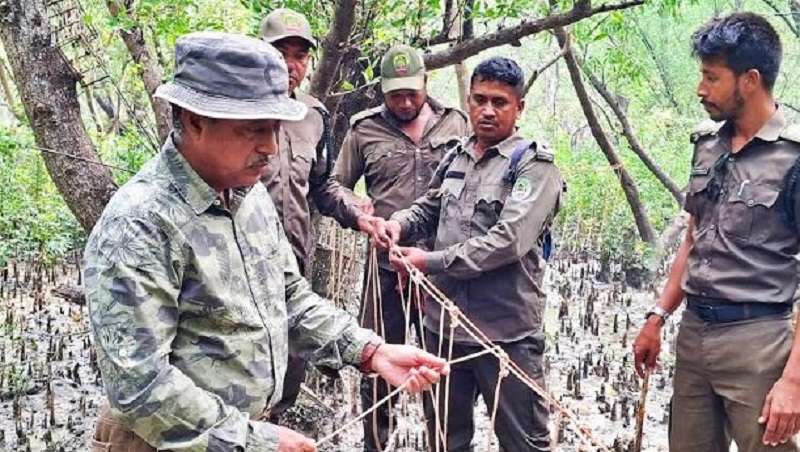
Divisional Forest Officer Mohammed Rezaul Karim Chowdhury and forest guards removing traps. 

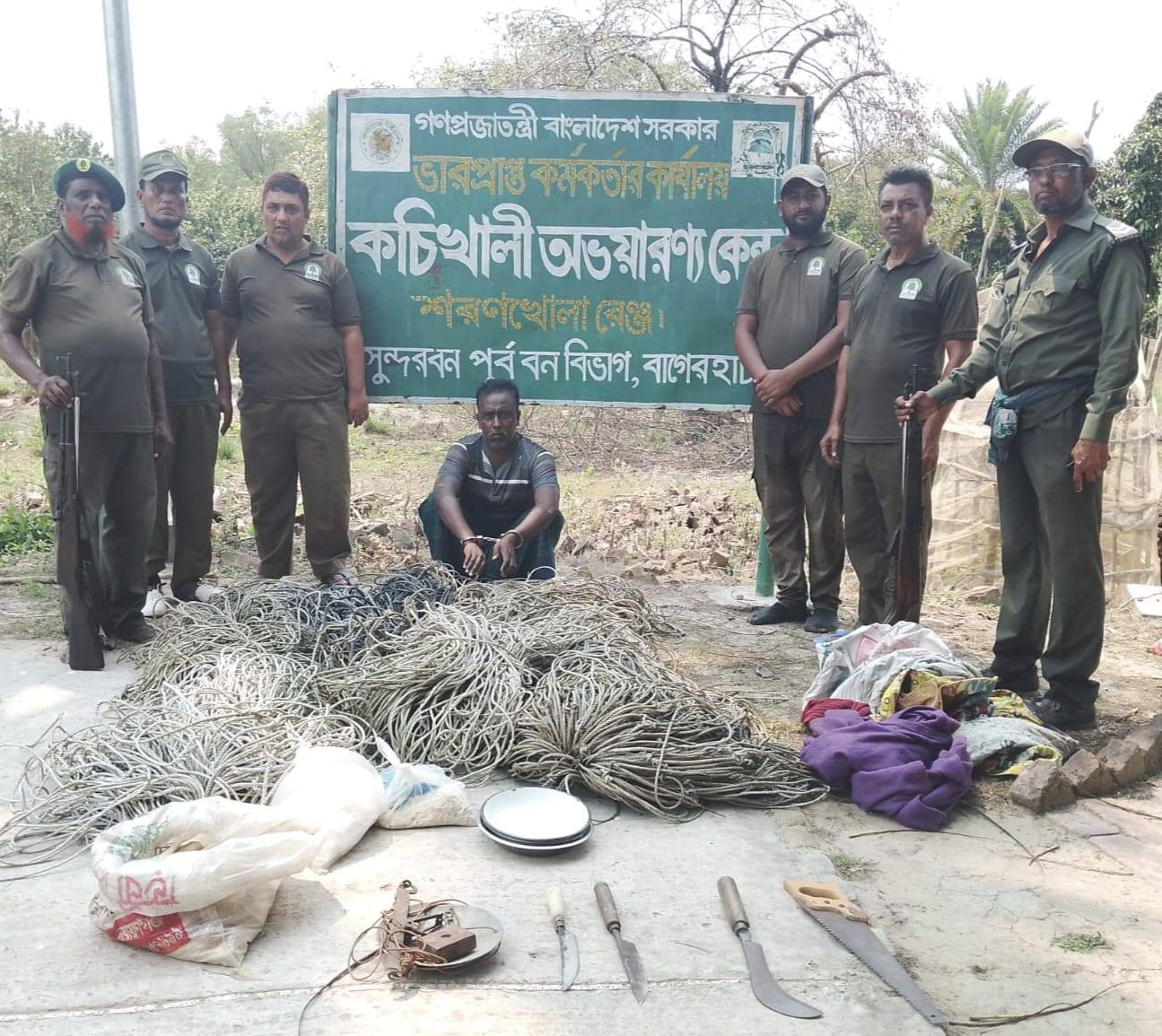
Deep within the tangled waterways and emerald mangroves of Bangladesh’s Sundarbans, a quiet transformation is unfolding. Forest officials and local communities say an unrelenting campaign against deer poaching and poison fishing has begun to restore balance to the world’s largest mangrove forest. Over the past year, prey populations have rebounded, and with them has come a striking increase in sightings of the elusive Bengal tiger — a powerful sign that the ecosystem is slowly healing. Between May 2025 and April 2026, the forest department launched 474 operations across the delta’s labyrinth of creeks and islands, dismantling sprawling networks of illegal traps and arresting 377 people in 241 separate cases. Rangers tore down more than 114,000 feet of deer snares, alongside hundreds of wire snare and walk traps — devices capable of killing thousands of deer, monkeys, wild boars and even tigers. Authorities also seized hundreds of boats and trawlers, thousands of crab traps, fishing nets, and over a tonne of poisoned fish and crab intended for illegal harvests. The impact of the crackdown is already visible. Illegal venison seizures have plunged from 750 kilograms last year to just 250 kilograms — a dramatic decline officials credit directly to the intensified enforcement effort. On the forest floor and from the skies above, patrol teams combined traditional foot operations with modern surveillance technology, including an expanded fleet of drones, to track poachers through the dense mangroves. According to Divisional Forest Officer Mohammed Rezaul Karim Chowdhury, authorities prosecuted 70 individuals for setting traps, while 300 fishermen were jailed for illegal entry and poison fishing. Hundreds more now face charges under forestry law, as Bangladesh intensifies its battle to protect one of the planet’s last great wildernesses.

Forest guards with a poacher and several confiscated traps.

The effects of the crackdown are now echoing far beyond the forest patrols — they are being written into the very rhythm of the Sundarbans itself. Honey collectors and fishermen, many of whom have spent more than 15 years navigating these shadowy waterways, say the forest feels alive again in ways they have not witnessed for over a decade. Tiger pugmarks press freshly into the mudbanks, distant roars once again ripple through the mangroves at dusk, and sightings of the great Bengal tiger have become increasingly common — including the extraordinary spectacle of the predators swimming silently across tidal rivers. Elsewhere, the forest’s recovering pulse can be seen in growing herds of deer, more frequent encounters with crocodiles and wild boars, and the return of rare birdlife to the canopy above. Birdwatchers and locals alike report rising sightings of the ruddy kingfisher, masked finfoot and white-bellied sea eagle — species whose presence signals a healthier, more balanced ecosystem. Ecologists say the revival is no coincidence. By curbing poison fishing and relentless wildlife poaching, authorities have allowed the intricate food web of the mangrove forest to begin repairing itself. Mohammad Raihan Ali, director of a research institute focused on the Sundarbans and coastal ecosystems, explained that every element of the forest is interconnected, making this chain reaction of recovery both expected and profoundly significant. The forest department says illegal fishing and crab harvesting in the Kochikhali, Kokilmoni, Kotka and Tiyarchar sanctuaries have now fallen to near-negligible levels. Conservation measures have also expanded beyond anti-poaching drives, with teams removing deadly gillnets from dolphin sanctuaries, enforcing plastic-free tourism policies and deploying drones to monitor fire-prone stretches of the fragile mangrove wilderness.

Boats patrolling the Sundarbans.

Over the past year, Bangladesh’s forest department has made remarkable progress in safeguarding the fragile wilderness of the Sundarbans. Through relentless enforcement operations and closer cooperation with local communities, poaching and other wildlife crimes have been pushed back, allowing the forest’s battered ecosystems to begin recovering. Yet the transformation has not come from patrols alone. Awareness campaigns have also reshaped attitudes among villages bordering the mangroves, fostering a growing sense of stewardship toward the forest and its wildlife. That change is already visible in extraordinary ways. In recent months, villagers chose to rescue and hand over three deer, one wandering Bengal tiger and 37 pythons that had strayed into human settlements — encounters that might once have ended very differently. Conservationists see these acts as powerful signs that coexistence between people and wildlife, long strained by fear and hardship, may slowly be taking root.

A 2024 survey recorded 125 tigers roaming the Sundarbans, and researchers believe that number could rise further if the current pace of conservation is sustained. But despite the encouraging momentum, the battle to protect the world’s largest mangrove forest is far from over. Organized bandit groups continue to operate deep within the waterways, creating an atmosphere of fear for fishermen and honey collectors who depend on the forest for survival. The vastness of the Sundarbans itself — combined with limited manpower, remote terrain and rivers increasingly choked by silt — makes enforcement an immense challenge. According to Shaikh Faridul Islam, the ministry is committed to taking every necessary measure to defend the Sundarbans, including joint-force operations aimed at dismantling criminal networks operating inside the forest. Officials say protecting the region now means confronting not only wildlife crime, but also the growing security threats faced by both local communities and forest staff.

For those who venture into the mangroves each day, danger remains ever-present. Tigers still roam the forest creeks and mudflats, and attacks continue to occur. Just recently, a honey collector survived a tiger encounter that could easily have turned fatal. Conservationists stress that stronger safety measures, better awareness and strict adherence to forest guidelines are essential to reducing conflict between humans and wildlife. In the Sundarbans, survival has always depended on balance — between land and sea, predator and prey, people and wilderness. The forest’s recent revival offers a rare glimpse of hope. But preserving that fragile recovery will demand constant vigilance, deeper cooperation and the courage to protect one of Earth’s last great natural strongholds from the many dangers that still lurk beneath its tangled canopy.

Friday, May 15, 2026

How Pangolin DNA Is Exposing the Hidden Routes of Illegal Wildlife Trafficking

A white-bellied pangolin displayed by a local vendor in Nimba County, Liberia.

The pangolin is one of nature’s most extraordinary and enigmatic mammals, instantly recognizable by the suit of overlapping keratin scales that shields its body like living armor. Beneath this remarkable defense lies a creature superbly adapted to its environment: powerful curved claws rip open anthills and termite mounds with ease, while an exceptionally long, sticky tongue allows it to consume thousands of insects in a single night. Some species even navigate forest canopies with surprising agility, relying on prehensile tails to balance and grip branches as they climb. Yet, despite millions of years of evolutionary refinement, pangolins now face a far greater threat than any natural predator. They have become the world’s most heavily trafficked mammals, accounting for nearly one-third of documented international wildlife seizures in recent years. Throughout much of their native range, their meat is considered a delicacy and their scales are sought after for use in traditional medicine, driving a vast and devastating illegal trade.
Pangolins among snakes and other reptiles on display for consumption in Myanmar

A groundbreaking new study has revealed that even tiny traces of pangolin DNA can expose the hidden networks driving the global illegal wildlife trade. Published in PLOS Biology, the research by Sean Heighton and Philippe Gaubert of the University of Toulouse and the Research Institute for Development used an advanced gene-capture technique capable of retrieving valuable genomic information from severely degraded samples. The team analyzed DNA from more than 700 Chinese, Sunda, and white-bellied pangolins collected from bushmeat markets, field sites, museum collections, and international seizure records. By comparing these samples with genetic data from wild and archived specimens, the researchers constructed a detailed genomic “reference map” that allowed trafficked pangolins to be traced back to their likely geographic origins. The findings uncovered major poaching hotspots, including southwestern Cameroon, Myanmar, and multiple regions across Africa. The genetic evidence also illuminated key smuggling corridors operating across the borders of China and among islands in Indonesia. More importantly, the study revealed how domestic and international wildlife markets are deeply interconnected, often exploiting the very same wild pangolin populations and placing increasing pressure on an already vulnerable species.

A pangolin prepared for cooking.

This genetic sampling technique could mark a transformative turning point in the fight against illegal wildlife trafficking. The pangolin study demonstrated that even degraded DNA samples can be traced back to their geographic origins with remarkable accuracy, offering conservationists a powerful new tool to combat poaching. By pinpointing critical sourcing regions and trafficking corridors, genomic tracing enables more strategic, intelligence-driven conservation efforts, allowing limited resources to be directed toward the areas where intervention is needed most. Such targeted approaches could significantly improve efforts to dismantle illegal trade networks before vulnerable populations are pushed closer to extinction.

Confiscated pangolin scales set to be destroyed in Cameroon in 2017.

Sean Heighton emphasized that one of the study’s most significant achievements was the creation of a single gene-capture kit capable of working across all eight pangolin species, including highly degraded museum specimens. This innovation makes large-scale genomic tracing far more practical, accessible, and scalable for conservation efforts worldwide. Meanwhile, Philippe Gaubert noted that although much of the domestic pangolin trade operates locally, it often draws from the same source populations that feed international trafficking networks, underscoring the deep interconnectedness of these markets. Despite its enormous promise, the researchers caution that available genetic material remains limited. To fully realize the potential of genomic tracing, the authors advocate for the development of a comprehensive global DNA database for trafficked species, supported by standardized genetic sampling protocols, shared analytical tools, and stronger collaboration among wildlife trade monitoring initiatives worldwide. Expanding such efforts for pangolins and other heavily trafficked animals could become a crucial step toward disrupting the illegal wildlife trade on a global scale.