Wednesday, March 25, 2026

The Mexican Wolf Returns to Mexico: From Brink to Wilderness

A Mexican wolf being released into Mexico's Durango state.

For centuries, the Mexican wolf roamed freely across the rugged mountains and forests of northern Mexico and the American Southwest. But as human expansion spread, its haunting call grew faint—silenced by decades of persecution and mounting human pressures. By the mid-20th century, the species had all but disappeared from the wild. Its survival, however, would depend on an extraordinary alliance. In the 1970s, Mexico and the United States launched a binational effort to pull the Mexican wolf back from the brink. Agencies such as the Arizona Game and Fish Department, the New Mexico Department of Game and Fish, and the U.S Fish and Wildlife Service worked alongside Mexico’s Comisión Nacional de Áreas Naturales Protegidas (CONANP) and the Secretaría de Medio Ambiente y Recursos Naturales (SEMARNAT). Through captive breeding, cross-fostering, and carefully managed reintroductions, a subspecies on the edge was given a second chance. Today, its numbers are slowly rising—more than 300 wolves in the United States and a fragile but growing population in Mexico.

Now, in the remote spine of the Sierra Madre Occidental, a new chapter begins. After more than fifty years of silence, a wolf pack has returned to the wilds of Durango. An alpha pair, accompanied by their two young pups, has made a quiet journey south from the United States—carrying with them the legacy of decades of conservation work. Their arrival is the result of deep collaboration across borders. Supported by U.S. wildlife agencies and Mexican conservation authorities, the wolves were transported to the forested lands of El Tarahumar and Bajíos del Tarahumar, in the municipality of Santa Catarina de Tepehuanes. Here, landscapes carefully managed by ejidos and local communities remain rich and intact—offering a rare refuge where the species can once again take hold. For now, the pack waits—held within a pre-release enclosure, learning the rhythms of their ancestral home. The scent of pine, the movement of prey, the distant sounds of the forest—all are new, yet deeply familiar. Soon, they will step beyond the boundary and disappear into the wilderness. When they do, scientists from both nations will follow their journey through radio telemetry and camera traps, tracking each movement as the story unfolds. But the wolves’ future will depend on more than science alone. It will rest on coexistence—on the fragile balance between people and predator. And if that balance can be found, the ancient howl of the Mexican wolf may once again echo across the mountains of Durango.
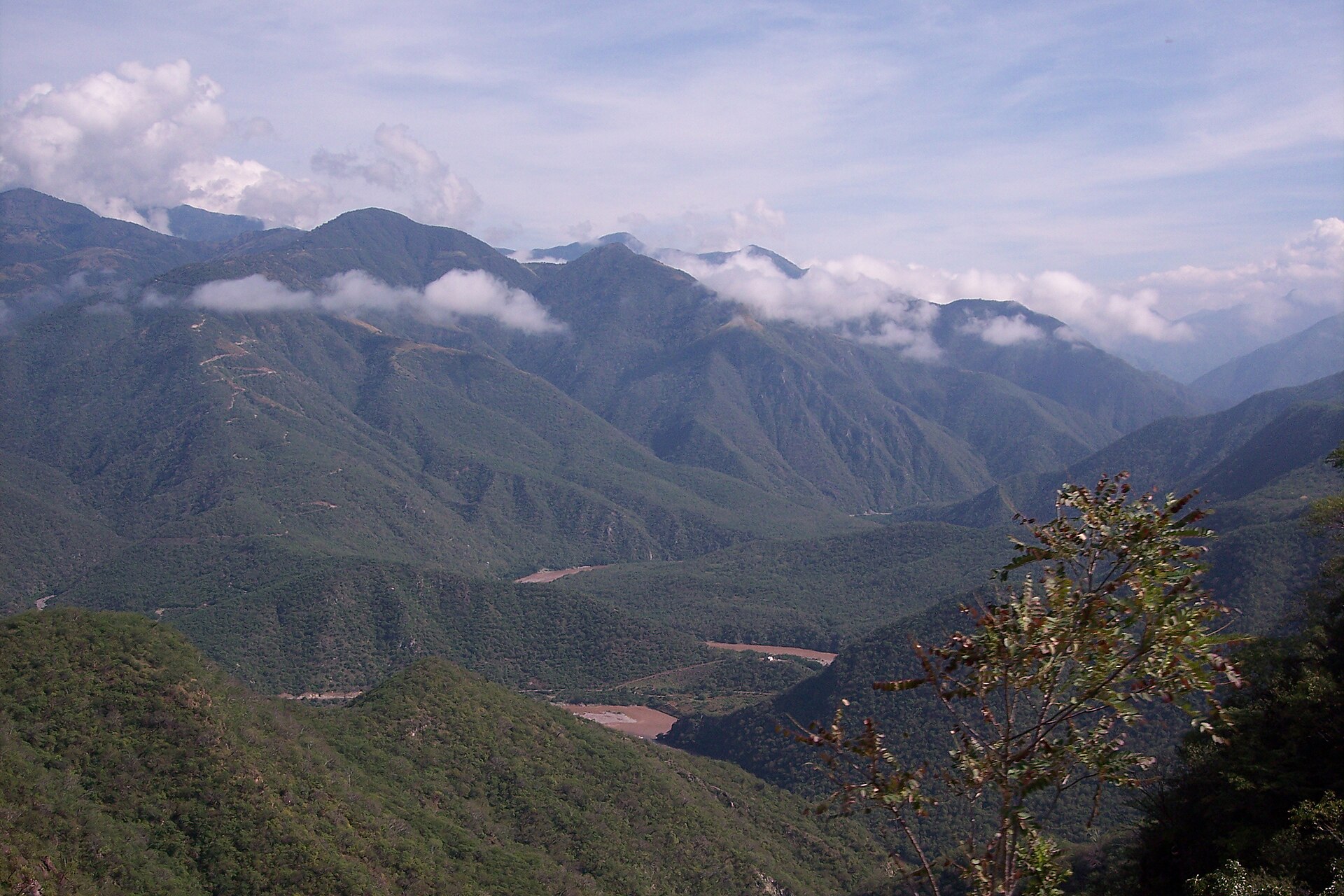
Sierra Madre Occidental with Santiago River winding through it.

The return of these wolves to Durango is more than a single conservation milestone—it is the living proof of a decades-long partnership between nations. Since the 1970s, agencies such as the U.S. Fish and Wildlife Service and the SEMARNAT, working alongside initiatives like the Saving Animals from Extinction (SAFE) program, have helped guide the Mexican wolf’s fragile recovery. Through their shared efforts, wolves have begun to reclaim fragments of their former range on both sides of the border. Now, with just 45 individuals in Mexico, the arrival of this small pack in Durango carries outsized significance—a signal of cautious hope. As they are monitored and studied, plans are already forming for a second reintroduction into the Sierra Madre Occidental, extending this slow return to the wild.

Yet the fate of the Mexican wolf will not be decided by wilderness alone. Its survival depends on a delicate balance between predator and people. Across forests and ranchlands, coexistence must be carefully built—through education, awareness, and the use of non-lethal measures that protect both livestock and wolves. Mexican authorities are working closely with rural communities to foster this relationship, but the challenge stretches beyond borders. In the ranching landscapes of the American Southwest, the same coexistence must take root. Only then—through shared responsibility, understanding, and respect—can the story of the Mexican wolf truly come full circle, its echoing howl once again a lasting presence across the lands it has long called home.

Friday, March 20, 2026

A Game of Survival: How Game Theory Is Transforming Tiger Conservation

A schematic image describing the study.

In wildlife conservation, a key priority is identifying corridors that allow animals to move safely between habitats. Traditionally, this has been done by mapping habitat connections using GPS collar data, aerial imagery, and field evidence such as tracks, scat, and camera trap footage. However, researchers in India have introduced an innovative approach to better understand how tigers navigate an increasingly human-dominated landscape. Led by a team from the Indian Institute of Remote Sensing and IILM University, the study focused on the Central Indian region, which is home to nearly 40% of the country’s tiger population. Their findings highlighted the PenchKanhaAchanakmar landscape as a critical movement corridor, offering a data-driven framework to prevent tigers from becoming isolated in fragmented forest patches. To examine the impact of habitat fragmentation, the researchers applied concepts from game theory—the study of strategic decision-making in situations where outcomes depend on multiple interacting agents. Using the Hawk–Dove model, they treated tigers as decision-makers weighing potential rewards against risks. In this context, the reward is access to prey-rich forests, while the risks include human-made barriers such as roads and railways. By simulating these trade-offs across a digital landscape, the team was able to predict the routes tigers are most likely to choose. They further integrated graph theory, representing forest patches as interconnected nodes in a network. This allowed them to pinpoint which areas function as vital links, maintaining connectivity across the broader ecosystem.

The game-theoretic approach integrates insights into tiger behavior with the influence of specific human-made obstacles. By assigning payoff values to different landscape features, the researchers can predict not just where a tiger might travel, but the routes it is most likely to choose to maximize its chances of survival. This results in a more nuanced and realistic understanding of how animals navigate landscapes that are constantly being reshaped by human activity. However, the team emphasized the need for more empirical data from GPS-collared tigers to validate these predictions—specifically, to determine how closely real-world movement patterns align with the model’s projected pathways.

The application of game theory to tiger movement highlights the powerful role that mathematics and scientific modeling can play in wildlife conservation. This study represents a promising step forward in identifying and protecting critical wildlife corridors, particularly for wide-ranging species like tigers, while supporting their safe movement into new territories. By pinpointing likely bottlenecks—areas where tigers are most at risk of encountering human settlements—this approach can guide more informed planning decisions, such as where to build wildlife crossings or limit infrastructure development. Ultimately, it demonstrates that with the right combination of data, technology, and analytical tools, it is possible to balance rapid human expansion with the ecological needs of apex predators, allowing both to coexist and thrive.